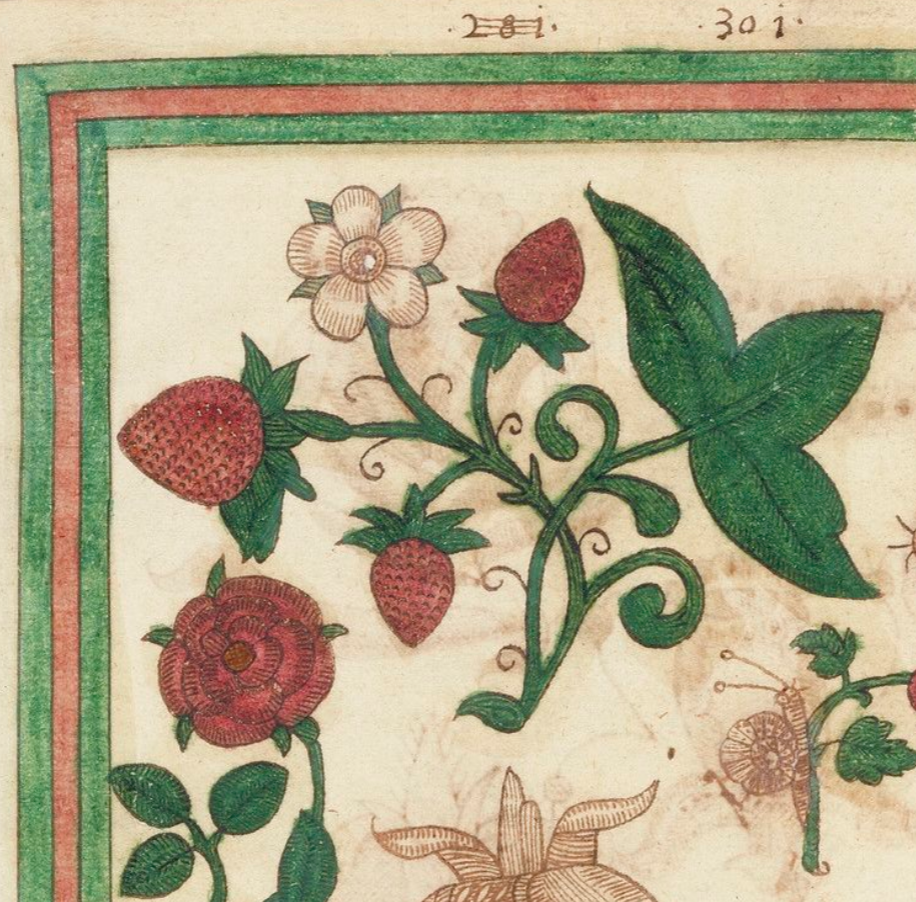
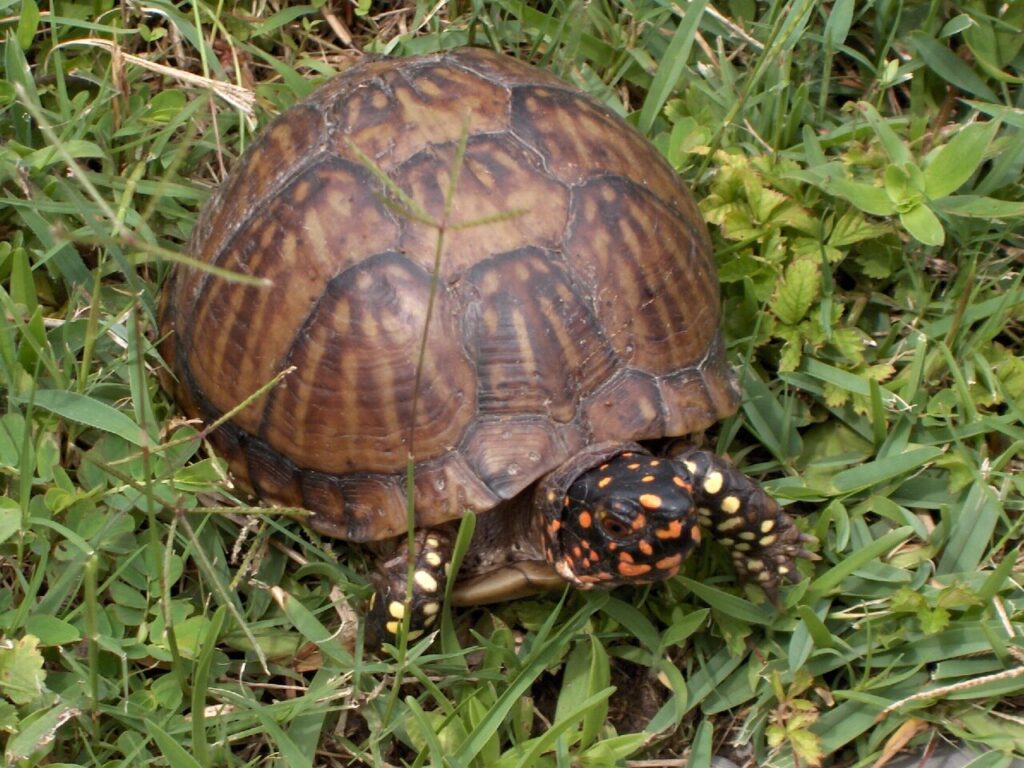
Another plant that might be planted in the fall, in addition to garlic, that comes to mind are strawberries. Honestly, I have a bit of an aversion to growing strawberries. We had them in our garden for a while when I was a kid, and they seemed like they were more work (weeding) than they were worth for the small yield. I think we got more wild strawberries than cultivated ones. We used to pick wild strawberries (Fragaria virginiana) with my grandmother along the top edge of the fields near the woods (they were smaller but tasted wonderful). Often we would find turtles (box turtle, Terrapene carolina) eating them along with us. She called them terrapins (a word for turtles of Algonquian origin), which in general is only used by people today to refer to aquatic turtles, which box turtles are not (but they are in the Terrapene genus). The Cherokee word for strawberries is ani, with a legend about how a woman who had a quarrel with her husband left him, but stopped along the way to pick strawberries, changed her mind, picked more to share, and went back to him.
Strawberries are in the rose family (Rosaceae), which is obvious from their white five-petaled flowers. The origin of why they are called strawberries in English is unclear. One theory is that it comes from strewn-berry, which I could see. The wild ones seem to be scattered about over the ground, especially as they get established from long runners.

Modern cultivated strawberries, Fragaria ananassa (named after pineapples, ?, ananas, which is originally from the Tupi language of South America), are hybrids between Fragaria chiloensis (from Chile) and Fragaria virginiana (from eastern North America) that were generated in the 1700s and selected because of their large fruit. (The parent species also appear to be the results of hybridizations among at least five ancestral species.) All three, the two parent species and the hybrid, are octoploids with eight copies of each chromosome. We are used to thinking about diploids, like us, with two copies of our genome, one from each parent. However, polyploidy with more than two copies is quite common in many plant species. There are many species of strawberries in Eurasia and the Americas, some are diploid like us, and some have other ploidies (like our common garden varieties) going all the way up to a couple of decaploid (10 copies of each chromosome) species.

We are a very visually oriented species. When we buy fruit in the grocery store, we primarily choose it based on what the fruit looks like (large, nice color, and unblemished; novelty can be a plus) in comparison to the others around it or compared to what we are used to seeing, not its taste or nutritional value. Genomes are huge. It takes space to pack all of that DNA into a cell and more resources to maintain it. Larger cells, in turn, seem to translate, through unknown precise mechanisms, into larger plant parts, including the fruit. It is not a perfect relationship, but there is a trend of more DNA equalling larger fruit, which has an economic advantage when humans are selecting among them. How do you pack more DNA into a cell? Polyploidization, add more genome copies. European varieties of strawberry were diploid or hexaploid, which put them at a disadvantage to American octoploids. (Again, the correlation is not perfect, Fragaria virginiana, eight copies, are quite small but Fragaria chiloensis, also eight copies, were noted from the beginning to be quite large compared to European strawberries with only two copies and six copies.) One trick in breeding new plant varieties for the market is to induce polyploidy (like treating them with colchicine from the crocus plant, which disrupts the chromosomes during cell division). When I am at the grocery store, it makes me wonder what we are actually paying for, more flavor and nutrition or more DNA (not that they are necessarily mutually exclusive)?
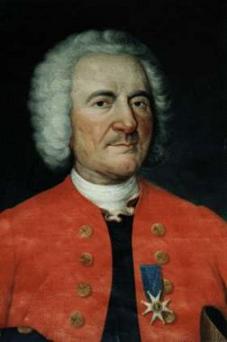
The manner in which the Chilean strawberries got back to Europe is a bit of a story. They were carried back by a French spy, Amedée François Frézier, sent by the French King, Louis XIV, who was known for his love of strawberries, to Chile to surreptitiously collect intelligence about Spanish forts in the region. He sailed there on a merchant ship in 1712 and posed as a merchant, noticed the large strawberries grown there, took some back to France, and gave some as gifts to various people. As a huge coincidence, his last name, Frézier, is derived from the French word (fraise) for strawberries, an example of nomen est omen.
Or is it a coincidence? As the story goes, an ancestor of the family, Julius de Berry, (Berry!) was knighted and received the family name in 916 for giving King Charles III a gift of strawberries. This came along with a coat of arms which can still be seen in the three strawberry flowers of the Fraser (of Philorth) Arms (which may or may not be related to the French family). Perhaps Amedée François Frézier saw it fitting to take strawberries back to France as a gift, recapitulating his family’s history.
Links
- Wikipedia articles on strawberries:
- Cherokee legend about strawberries; Mooney, J., (1902) Myths of the Cherokee. Washington, Government Printing Office. Available online at by Project Gutenberg, https://www.gutenberg.org/files/45634/45634-h/45634-h.htm#s12
- Discussion of the origin of the English word for strawberries; https://blog.oup.com/2015/04/strawberry-word-origin-etymology/
- Hirakawa, H., Shirasawa, K., Kosugi, S., Tashiro, K., Nakayama, S., Yamada, M., … & Isobe, S. N. (2014). Dissection of the octoploid strawberry genome by deep sequencing of the genomes of Fragaria species. DNA Research, 21(2), 169-181. https://academic.oup.com/dnaresearch/article/21/2/169/404005
- Yang, Y., & Davis, T. M. (2017). A new perspective on polyploid Fragaria (strawberry) genome composition based on large-scale, multi-locus phylogenetic analysis. Genome Biology and Evolution, 9(12), 3433-3448. https://academic.oup.com/gbe/article/9/12/3433/4554418
- Wu, J. H., Ferguson, A. R., Murray, B. G., Jia, Y., Datson, P. M., & Zhang, J. (2012). Induced polyploidy dramatically increases the size and alters the shape of fruit in Actinidia chinensis. Annals of Botany, 109(1), 169-179. https://academic.oup.com/aob/article/109/1/169/152826
- Vergauwen, D., & De Smet, I. (2019). The strawberry tales: Size matters. Trends in Plant Science, 24(1), 1-3. https://www.sciencedirect.com/science/article/abs/pii/S1360138518302401
- Article about the increase in plant tissue size associated with polyploids, https://medium.com/plant-cell-extracts/up-sizing-the-tale-of-the-polyploid-giants-508f9f7db , which references the following articles:
- Salman-Minkov, A., Sabath, N., & Mayrose, I. (2016). Whole-genome duplication as a key factor in crop domestication. Nature Plants, 2(8), 1-4. https://www.nature.com/articles/nplants2016115
- Robinson, D. O., Coate, J. E., Singh, A., Hong, L., Bush, M., Doyle, J. J., & Roeder, A. H. (2018). Ploidy and size at multiple scales in the Arabidopsis sepal. The Plant Cell, 30(10), 2308-2329. https://academic.oup.com/plcell/article/30/10/2308/6099406
- Atlas Obscura (2017) article “The 18th-Century Spy Who Gave Us Big Strawberries”, https://www.atlasobscura.com/articles/big-strawberries-spy-chile-france
- Wikipedia article about Amédée-François Frézier, https://en.wikipedia.org/wiki/Am%C3%A9d%C3%A9e-Fran%C3%A7ois_Fr%C3%A9zier
- Wikipedia article on nominative determinism, https://en.wikipedia.org/wiki/Nominative_determinism
- Wikipedia article on Julius de Berry, https://en.wikipedia.org/wiki/Julius_de_Berry
- Wikipedia article on the Frasers of Philorth, https://en.wikipedia.org/wiki/Frasers_of_Philorth
Media
- Strawberry image from p. 301 of the Trevelyon Miscellany of 1608:
- Box turtle image, https://commons.wikimedia.org/wiki/File:Eastern_box_turtle_(Terrapene_carolina)_(cda5786b-b3af-42fb-9331-62ccf64bee2a).JPG
- Chilean strawberry plant image by Frézier, https://commons.wikimedia.org/wiki/File:Planche_XI.jpg
- Amedée François Frézier portrait, https://commons.wikimedia.org/wiki/File:Amedee_frezier.jpg
_(cda5786b-b3af-42fb-9331-62ccf64bee2a).JPG)


Leave a Reply