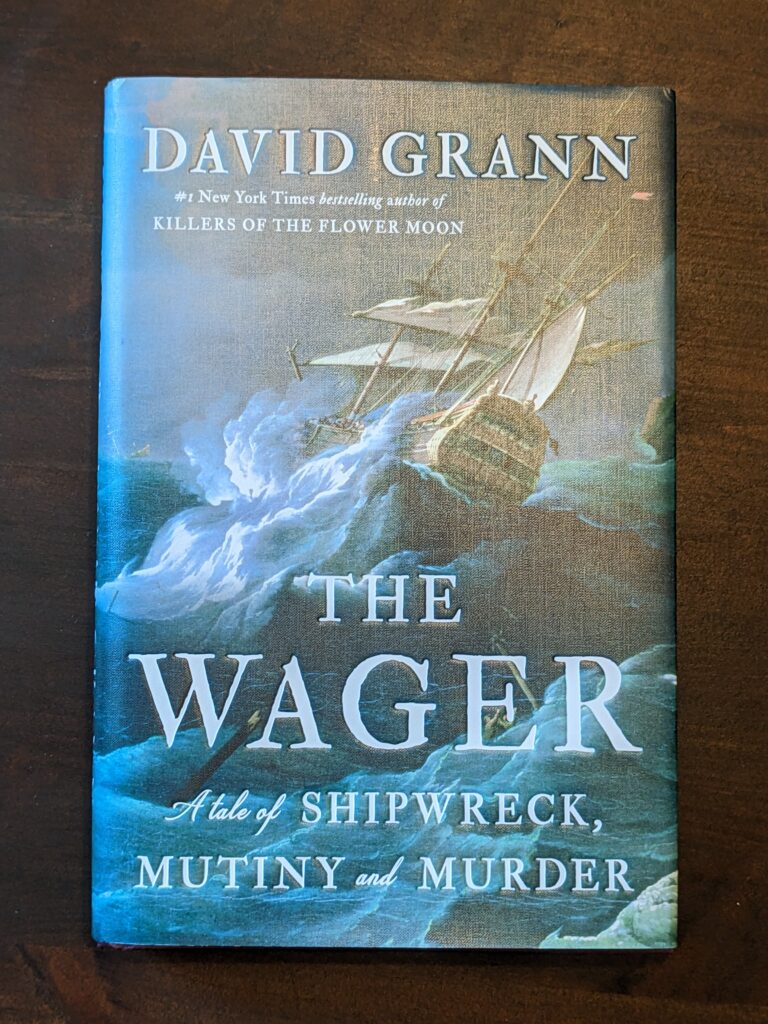
This is another book that I finished recently while moving, Grann’s 2023 The Wager. It focuses on a specific ship, the HMS Wager, that was part of Anson’s around-the-world Royal Navy voyage in 1740–1744. I heard an interview about it on the radio and was curious enough to order a copy to read.
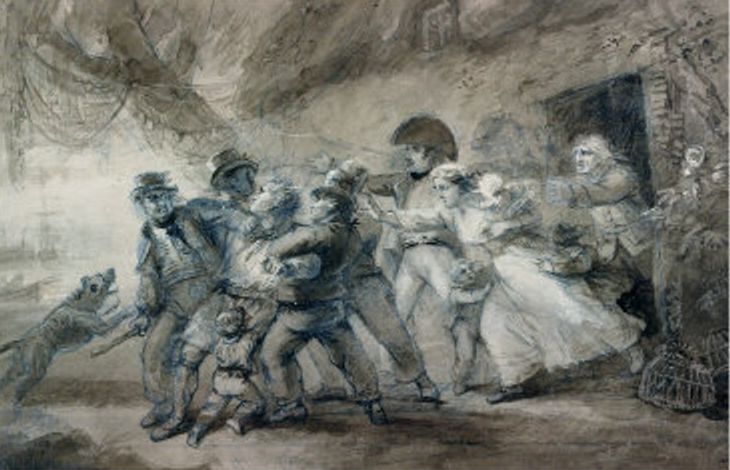
One thing that really stands out is the way people were treated. People were abducted (impressment and the press gang) and forced into servitude aboard a ship, where they were then not free to leave. Many of these people had families that they needed to provide for and were suddenly being shipped off for years-long voyages, perhaps never to return, with no way to tell their families or know how they would survive in their absence.
In addition to this were the conditions of the ship. Crowding and disease were a constant. Then there was violence, including warfare among ships and the constant threat of drowning (many sailors could not swim). Scurvy from a lack of vitamin C was a major factor. (Humans have a mutated inactive form of GULO; the gene that produces vitamin C in other species.) Anson lost 2/3 of his crew, the majority of these due to scurvy. This led James Lind to rediscover (this had already been known at certain times and places and then unfortunately forgotten) that citrus fruit prevented scurvy while at sea, but it still took time for this to be incorporated into the practices of the Royal Navy.
Given the forced servitude and living conditions, is it any wonder that thoughts of mutiny were not far away? When the crew was shipwrecked, they faced a whole new host of problems finding food, water, and shelter on a Patagonian island. Reading this gave me an appreciation of wild celery (Apium spp.) that the sailors found on the island, and it cured their scurvy.
The book appears to be well-researched and well-written. It is informative about this period of the British Navy and life aboard a ship. However, I felt it to be surprisingly anti-climatic (side-stepping details in order not to go into spoilers). This is no fault of the author. He can’t control how things work out in a non-fiction work of the history surrounding an event. It might be highly recommended to people specifically interested in the time period and history of sea fairing, but I have to say, reluctantly, that I don’t really generally recommend it. Rather, I would highly recommend some of the Patric O’Brian Aubrey-Maturin fictional novels to illustrate naval ship life in the British Royal Navy during the Age of Sail, such as the HMS Surprise.
Links
- The Wager
- https://en.wikipedia.org/wiki/George_Anson%27s_voyage_around_the_world
- https://en.wikipedia.org/wiki/HMS_Wager_(1739)
- https://en.wikipedia.org/wiki/Impressment
- https://en.wikipedia.org/wiki/Scurvy#18th_century
- https://en.wikipedia.org/wiki/Aubrey%E2%80%93Maturin_series
Wordlist
- Apropos—appropriate or regarding. From French, with regard to a specific purpose.
- Burnishing—polishing (origin means to brighten).
- Calumnies—slander.
- Circumspect—wary and holding back.
- Distemper—today, this mostly refers to animal diseases, but it used to be more general, including human diseases and referred to a disruption in the balance of the four humors.
- Doss-houses—flophouse.
- Execrations—curse.
- Fecklessly—incompetent.
- Hobbesian—a society with an absolute ruler and an absence of individual freedoms.
- Indefatigable—tireless. From not-fatigued.
- Indomitable—undefeatable. From not-dominate-able.
- Je ne sais quoi—French, a quality that is hard to define. Literally, “I don’t know what”.
- Missive—a long, perhaps official, letter.
- Obstinacy—stubborn.
- Poignant—causing sadness.
- Poltroons—cowards.
- Privation—where something essential, like food or shelter, is lacking.
- Propitious—favorable.
- Recalcitrant—uncooperative.
- Sagacious—good judgment.
- Scorbutic—affected with scurvy.
- Slip—a boat dock that is enclosed on three sides.
- Taciturn—terse and reserved.
- Unknelled—without a bell rung (as at a funeral), passing away unobserved.
Media

Leave a Reply