After reading Ballantyne (1861) I was looking for a book about colonialism from an African perspective. Things Fall Apart (1958) by Chinua Achebe (who was Igbo and grew up in British Colonial Nigeria) is exactly the kind of book I was looking for.
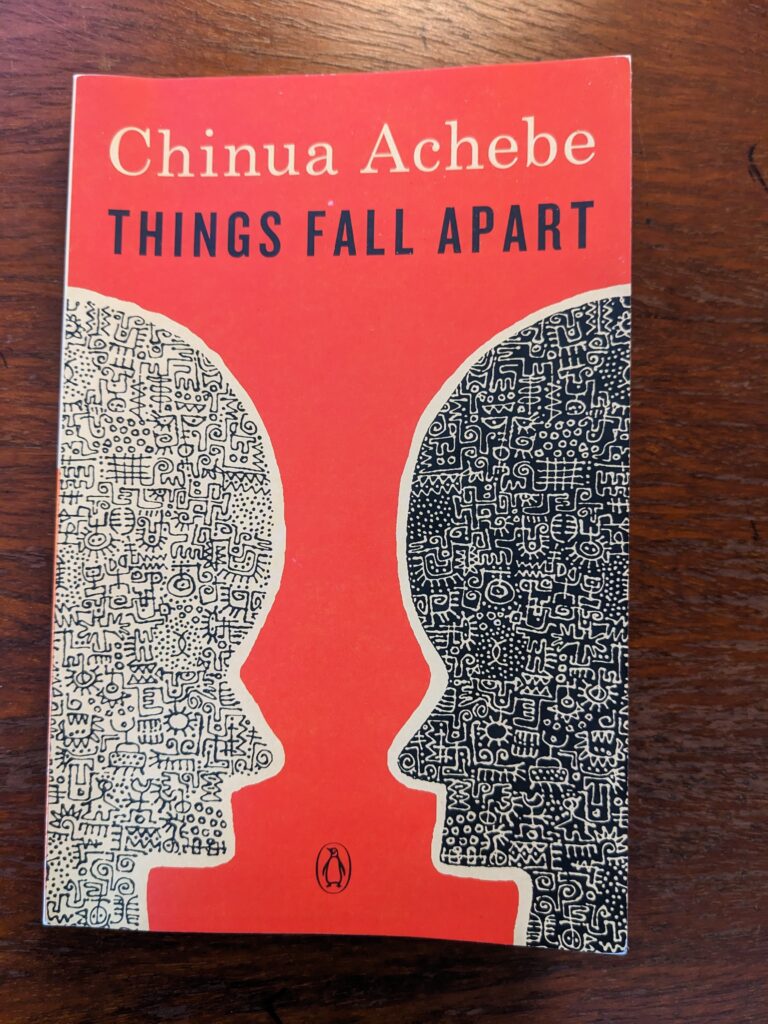
The book starts off by drawing you into West African Igbo (or Ibo) village life, both the good and the bad; it doesn’t feel like a sanitized noble or exaggerated brutal version in either direction. (I say “feel” because obviously, I don’t know what traditional Igbo life was actually like.) A key is that the book is centered around the life of a single man, Okonkwo, putting it into a personal perspective. The Igbo culture is proud and complex and is embodied to a large degree by Okonkwo. It is set in the late 1800s during a time of change and colonization that does not move to the forefront until a rapid series of events late in the book, setting a solid pre-colonial baseline to work from. (However, hints of imperceptively slow change are present earlier, like the occurrence of plants from the Americas: cassava, tobacco, and corn.) The irreversible early steps of colonization, starting with missionaries gaining a foothold for a period of time and then abruptly followed by physical force and coercion from the British administrators, are frustrating to see unfold. To the reader, this would be predictable (with our hindsight), but from the Igbo point of view, the magnitude and forces of change are unclear, which makes it all the more painful to read as they try to accommodate the newcomers despite the early warnings. The last paragraph of the book is placed and cast perfectly, suddenly breaking from the rest of the book and putting everything into the stark perspective of the colonizing power.
I found this book while searching for a counter-perspective to Ballantyne (1861). However, it is clearly in a different league. I highly recommend reading it in its own right. It also flowed by. I am typically a slow reader. I’ve never understood how some people can read a book in a weekend or even a day, but I finished this book in near record time.
I mentioned negative aspects of Igbo culture above but didn’t want to bog down the overview paragraph with it, so I moved the details here. Like all cultures, it is a mix of good and bad from a modern Western view. There are various forms of violence and horrible cruelty contained in the book. The book isn’t apologetic about this and does its job of quickly placing you into Igbo perspectives remarkably well. Misgivings about some aspects of the culture are conveyed through more minor characters rather than Okonkwo. Stepping back for a moment: We should work to be aware that we are judging another culture from our perspective and how we are doing it, including (sometimes cryptic to us) hypocrisy. We have our own forms of violence and cruelty in modern Western culture (I am avoiding the temptation to list some examples because this would quickly devolve into a sidetracked political discussion based on which examples I choose) that are all too easy to overlook by many because, unfortunately, we are used to them (i.e., don’t have an outside perspective) and/or they often do not affect us directly.
It is interesting to reflect on how the process of colonial domination worked. There was not (on the whole, in the description in this book; the wider historical picture is complex) direct war and physical military conflict, which people would have immediately been on their guard against. Instead, the British were well practiced in this (whether fully conscious of the strategy or not) and used what had worked in other circumstances, worming their way in. They followed the missionaries after they had begun dividing loyalties and undermining the traditional culture, weakening people by turning them against each other (again, whether they were aware of the strategy or not). Then the British established more and more bureaucratic power in a series of administrative steps that opportunistically cut off individual leaders from their connections to power (other Igbo) in ways that they were not used to guarding against. The British administrators also threatened retribution against important individuals under their control if the entire group of people did not comply. During this process, the British were increasingly working through disruptive intermediaries (who are learning tricks to become financially successful within a bureaucracy) to shield themselves from physical harm and labor and promote a view of their inaccessibility. While not “Orwellian” in the strict sense, the process does bring to mind the writing of George Orwell.
One of the great things about how this book is written is that it accessibly introduces a wide range of Igbo vocabulary. I filled up two notecard bookmarks with terms, most of them Igbo, in my wordlist from this book. I list them at the end of this post; however, I found out near the end of reading the book that there is a partial glossary(!) at the back of the book. However, it didn’t feel immediately necessary to look the Igbo words up because they are explained by the author or are in context. (He did an expert job of this without breaking the flow of the reading.) Midway through the book, you are automatically translating more commonly used terms like obi, foo-foo, and chi in your mind while reading.
Achebe invokes a couple of clear ties to other classic works. The phrase used for the title, “things fall apart”, is from Yeats’s (1919) The Second Coming about Europe after World War I, which was written in the setting of the Irish War of Independence and the 1918 flu pandemic. The phrase “red in tooth and claw” is also used, which is from Tennyson’s (1850) In Memoriam A.H.H. about nature’s uncaring cruelty and how this conflicts with (Victorian) morality.
A personal note about kola nuts, which occur multiple times in this book (and Coca-Cola is, in part, named after): I traveled in West Africa in 2010 and was offered a kola nut in a rural village. I won’t simply write that they taste horrible; instead, let’s just say it must be an acquired taste. All of the people around me were watching me closely to see how I would react. After the first seconds of tasting it, I spit it out and declined more. (They are not swallowed; do not swallow them! They contain a tremendous amount of caffeine.) We were all in on the joke, and they laughed.
The background and issues are far too numerous to list here, but it is worth noting how reading this book can fit in with interpreting later developments in Nigeria, like Nigerian independence in 1960, the brief independence of the predominantly Igbo Republic of Biafra from 1967 to 1970 with the Nigerian Civil War, and broader issues like the ongoing oil drilling in the Niger Delta.
Word list:
This is a personal list and includes some words that may or may not be already well known to everyone to remind me to practice using them more; however, you might also find it useful, especially the Igbo terms (warning, I have likely made some mistakes), so I am copying it here.
- Afa—an Igbo divination system.
- Afo—one of the days in the four-day week.
- Agadi-nwayi—old woman.
- Agbala—woman, also an oracle.
- Ajofia—Evil Forest, also one of the masked people in a ceremony.
- Akakanma—an age group.
- Akalogoli—ghost.
- Amadiora—god of thunder and lightning, among other things.
- Ani—earth goddess.
- Approbation—approval.
- Bitter-leaf soup—a soup that includes the leaf of what might be Vernonia amygdalina.
- Brusqueness—an abrupt rude manner.
- Callow—naive.
- Cam wood—Baphia nitida, also known as African sandalwood, can be used to make a red dye and also a type of soap.
- Chi—personal spirit.
- Chukwu—the Igbo supreme God.
- Coiffure—styled hair.
- Dispensation—rules or an official exception to rules.
- Efulefu—a worthless man.
- Ege style—appears to be a style of wrestling, but I couldn’t find out much about it.
- Egusi soup—a soup made from egusi (a type of melon) seeds.
- Egwugwu—a masked person representing an ancestral spirit in an Igbo ceremony.
- Ekwe—a hollow wood drum with slits in the side that can be used as a “talking drum”.
- Ekwensu—a trickster spirit.
- Foo-foo—pounded yam food.
- Grandees—a person of high rank.
- Harbinger—a sign of a future event or a person that announces it.
- Harmattan—a dry, windy season in West Africa.
- Iba—malaria.
- Idemili—female water spirit or goddess.
- Ifejioku—a goddess associated with yams and farming.
- Ikenga—a spirit, or representation of a spirit, representing individual achievement.
- Iguedo—the name of the village most of the novel is set in.
- Ilo—an outside cleared area for meetings and sports.
- Inyanga—bragging.
- Iroko tree—African teak, Milicia excelsa.
- Improvident—thoughtless.
- Isa-ifi—a bridal ceremony.
- Iyi-uwa—a physical object that a type of evil child spirit (ogbanje) uses to bind itself to the world and return to be born again after the death of the child.
- Jigida—a string of beads worn around the waist.
- Kola nut—A seed of a tree in the Cola genus that contains caffeine.
- Kotma—short for “court-messenger”.
- Ndichie—elder leader.
- Nna ayi—a repectful greeting.
- Nne—mother.
- Nno—welcome.
- Nso-ani—a major offense.
- Nza—a small bird.
- Obi—the most important central house in a family compound.
- Ochu—murder.
- Ogbanje—An evil child spirit that returns to be born again.
- Ogbu-agali-odu—an evil force.
- Ogene—metal bell.
- Ogwu—witchcraft or medicine.
- Ogwugwu—a market day deity.
- Openhanded—generous.
- Osu—outcasts.
- Otakagu—an age group.
- Oye—one of the market days.
- Ozo—a rank in society.
- Pottage—a thick soup.
- Prophesying—divine a future event.
- Raffia—A genus of palm, Raphia, that produces long fibers used to make cloth. This also refers to the fibers and the coarse cloth.
- Silk cotton tree—the species Ceiba pentandra.
- Singlets—one-piece garments.
- Sisal—a plant, Agave sisalana, that produces a strong fiber.
- Tares—weeds? I wrote this down, but now I am not sure of the context.
- Tie-tie—a rope or to tie together.
- Udala tree—a star apple tree, Gambeya albida, that produces edible fruit.
- Udu—a ceramic jug with an extra hole that is played as a musical instrument.
- Uli—abstract painted designs or the dye used to do this.
- Umuada—female kin folk.
- Umunna—male kinsmen.
- Umuofia—fictional Igbo clan.
- Umuofia kwenu—a greeting among the fictional Umuofia.
- Uri—a dowry marriage ceremony.
- Valediction—saying farewell or bidding goodbye.
- Voluble—talking with energy and excitement.
- Wan—weak.
- Wherewithal—the means needed.
- Wrought—made.
Links
- Wikipedia article on the book, Things Fall Apart, https://en.wikipedia.org/wiki/Things_Fall_Apart
- Things Fall Apart for sale on Amazon.com, https://www.amazon.com/dp/0385474547
- Wikipedia article about the author, Chinua Achebe, https://en.wikipedia.org/wiki/Chinua_Achebe
- Wikipedia article about the Igbo, https://en.wikipedia.org/wiki/Igbo_people
- Wikipedia article about traditional Igbo religion, https://en.wikipedia.org/wiki/Odinala
- Wikipedia article on the Igbo cultural region, https://en.wikipedia.org/wiki/Igboland
- Wikipedia article about Colonial Nigeria, https://en.wikipedia.org/wiki/Colonial_Nigeria
- Wikipedia article about Yeats’s (1919) The Second Coming, https://en.wikipedia.org/wiki/The_Second_Coming_(poem)
- Text of Yeats’s (1919) The Second Coming, https://www.poetryfoundation.org/poems/43290/the-second-coming
- Wikipedia article about Tennyson’s (1850) In Memoriam A.H.H., https://en.wikipedia.org/wiki/In_Memoriam_A.H.H.
- Wikipedia article about Nigeria, https://en.wikipedia.org/wiki/Nigeria
- Wikipedia article about the Republic of Biafra, https://en.wikipedia.org/wiki/Biafra
- Wikipedia article about the Nigerian Civil War, https://en.wikipedia.org/wiki/Nigerian_Civil_War
- Wikipedia article about conflicts in the Niger Delta of Nigeria, https://en.wikipedia.org/wiki/Conflict_in_the_Niger_Delta
Leave a Reply