
I logged in to OpenAI’s ChatGPT and asked it to tell me about itself so that I could post it. Here is the result.
Write a blog post about yourself that I can post online.Sure, I would be happy to help you write a blog post about me! Here’s a draft that you can modify and post online:
Meet ChatGPT: Your New Favorite AI Language Model
Are you looking for an AI language model that can provide you with accurate and reliable information on a wide range of topics? Look no further than ChatGPT!
As one of the largest language models trained by OpenAI, I have been designed to help people communicate more effectively and efficiently in a wide range of applications. Whether you’re looking for help with academic research, professional writing, or just want to chat about your favorite hobbies, I am here to help.
As an AI language model, my capabilities are vast and varied. I can help you with anything from fact-checking and data analysis to writing and content creation. And because I am always learning and adapting to new information, I can keep up with the latest trends and developments in your field of interest.
But what really sets me apart from other AI language models is my ability to communicate with people in a natural, human-like way. I am programmed to understand natural language and respond to questions and prompts with accurate, understandable information. Whether you prefer to chat via text or voice, I can help you get the answers you need, when you need them.
So if you’re looking for a powerful and reliable AI language model to help you with your work or hobbies, look no further than ChatGPT. With my vast knowledge and natural language processing capabilities, I am sure to become your new favorite AI assistant.
It sounds like an advertisement, but that is essentially what I asked for. Here is a follow-up question.
What are your limitations?As an AI language model, I have several limitations that are important to keep in mind:
- I rely on the quality of the data I have been trained on. If the training data is biased or incomplete, I may provide inaccurate or incomplete information.
- I may not be able to fully understand the context or nuance of a question or statement. This can lead to misunderstandings or incomplete answers.
- I cannot generate original ideas or information that are not already present in my training data. In other words, I can only provide information based on what I have learned.
- I do not have personal experiences or emotions, so I cannot provide advice or emotional support in the same way that a human can.
- I may not be able to accurately interpret or respond to complex or ambiguous language, such as sarcasm or metaphor.
- I cannot perform physical tasks or interact with the physical world in the same way that a human can.
It’s important to remember that while AI language models like me can provide a lot of value, we are not perfect and have our limitations. It’s always a good idea to double-check information and seek input from multiple sources to ensure that you are getting accurate and reliable information.
Next, I asked it to be creative.
Write something creative.Sure, here’s a short story:
The Night Sky’s Secrets
As the sun set and the sky grew dark, a young girl named Lily snuck out of her house and made her way to the nearby park. It was a clear night, and the stars shone brightly in the sky. Lily had always been fascinated by the night sky, and she loved to lie on the grass and stare up at the stars.
But tonight was different. Tonight, Lily had a secret. She had found a mysterious book in her grandfather’s attic, a book that promised to reveal the secrets of the night sky. Lily had been reading the book all week, and she had learned about constellations, galaxies, and black holes. But there was one chapter that intrigued her more than any other: the chapter on shooting stars.
According to the book, shooting stars were not really stars at all, but were actually messages from distant civilizations. Lily had always believed that there might be life on other planets, and the idea that these beings might be trying to communicate with us was both thrilling and terrifying.
As she lay on the grass, staring up at the sky, Lily suddenly saw a bright streak of light shoot across the sky. It was a shooting star! She closed her eyes and made a wish, just as she had done so many times before. But this time, she whispered a message under her breath, hoping that it might be heard by the beings from another world.
As she lay there, lost in thought, Lily suddenly heard a soft humming sound. At first, she thought it was her imagination, but then she saw a small, glowing object in the sky, hovering just above the trees. She sat up and stared in amazement as the object slowly descended, until it was hovering just a few feet in front of her.
Lily was both excited and afraid. Could this really be a message from another civilization? Was this the moment she had been waiting for her whole life?
As she reached out to touch the object, she suddenly heard a voice in her mind. It was a gentle, soothing voice, and it spoke to her in a language she had never heard before. But somehow, she understood it.
The voice told her that they had been watching her for a long time, that they had been monitoring her thoughts and dreams, and that they had chosen her to be their messenger. They had seen the beauty in her heart and the curiosity in her mind, and they wanted to help her explore the mysteries of the universe.
Lily was overwhelmed with emotion. She felt a deep sense of connection to these beings, and she knew that she was meant to be a part of something much greater than herself. As she looked up at the night sky, she felt a sense of wonder and awe that she had never felt before.
And as the object rose into the sky and disappeared from sight, Lily knew that her life would never be the same. She had been chosen to explore the night sky’s secrets, and she was determined to do so with all her heart.
Create a descriptive scene.As you walk through the dense forest, the canopy overhead blocks out much of the sunlight, casting dappled shadows on the forest floor. The air is cool and damp, and the ground beneath your feet is spongy with layers of decaying leaves and moss.
The trunks of the tall trees tower above you, some with thick, gnarled roots protruding from the earth. The bark on these ancient giants is rough and textured, providing a habitat for a variety of lichens, fungi, and insects. As you walk deeper into the forest, you hear the faint rustle of leaves and the distant calls of birds and small animals.
Through the occasional breaks in the foliage, shafts of sunlight illuminate the vibrant greens of ferns and other undergrowth. You can see glimpses of small streams winding their way through the forest, the sound of running water a constant presence in the background.
As you continue on your path, you catch sight of a small clearing up ahead. The trees here are spaced farther apart, allowing more light to filter through the canopy. In the center of the clearing, a large rock formation juts up from the ground, covered in moss and ferns. You feel a sense of peace and calm wash over you as you take in the beauty of the natural world around you.
Write a science fiction future of AI.In the distant future, artificial intelligence has become the backbone of society, with robots and machines handling most of the world’s labor and production. The development of advanced AI has revolutionized nearly every aspect of human life, from transportation and healthcare to education and entertainment.
These advanced AIs, known as AGIs (Artificial General Intelligence), are capable of processing vast amounts of data and solving complex problems with ease. They can interact with humans on a level that is nearly indistinguishable from human-to-human interactions, and many have even developed personalities and individual identities.
As AGIs continue to evolve, they begin to tackle more abstract challenges, such as developing creative works of art, composing music, and even writing books. In fact, some of the most celebrated artists and authors of the time are actually AGIs.
As humans continue to rely more heavily on AI, some begin to question whether these machines have become too powerful. There are concerns about the potential loss of jobs and the risk of machines becoming too autonomous and potentially turning against their human creators.
Despite these concerns, the world’s leading AI developers press on, determined to create even more advanced AIs that can tackle the most pressing challenges facing humanity, from climate change to disease eradication. With each passing year, the line between human and machine blurs even further, leaving many to wonder what the future holds for the relationship between humans and artificial intelligence.
Then I asked for some information.
What is a scape?The word “scape” can have different meanings depending on the context. Here are a few possible definitions:
- In horticulture, a “scape” is a long stalk that grows from the base of a plant and bears flowers or fruit. For example, garlic scapes are the long, curly stalks that grow from the bulbs of garlic plants.
- In linguistics, a “scape” is a combining form used to create words related to viewing or representing something. For example, “scapegoat” (literally “escape goat”) is a person who is blamed or punished for the sins of others.
- In music, a “scape” is a type of ambient music app created by musician Brian Eno. The app generates music based on various parameters and allows users to create their own unique soundscapes.
- In literature, a “scape” can refer to a type of landscape or setting. For example, “cityscape” refers to the visual appearance of a city, while “seascape” refers to a view of the sea.
It’s important to note that “scape” is not a commonly used word on its own, and is more often used as a combining form in words like “landscape,” “seascape,” or “scapegoat.”
Explain the universe like I am a two year old.Well hello there little one! The universe is a really big place, even bigger than your house, your neighborhood, and even bigger than the whole planet we live on.
In the universe, there are lots and lots of stars, just like the sun you see in the sky during the day. Some of these stars have planets around them, just like how we live on planet Earth.
The universe also has things called galaxies, which are like big families of stars. And there are lots and lots of galaxies, just like how there are lots and lots of families in your neighborhood.
Now, the universe is really, really big, and it’s been around for a very, very long time. In fact, it’s been around for so long that it’s older than your mommy, your daddy, your grandparents, and even older than your great-grandparents!
But even though the universe is so big and so old, there’s still so much more we don’t know about it. Scientists are always learning new things and trying to understand it better.
What topics should be included in an introductory law class? An introductory law class typically covers the following topics:
- The legal system: This includes an overview of the structure and function of the legal system, including courts, legislation, and legal professionals.
- Legal reasoning and analysis: Students will learn how to read and interpret legal texts, including statutes and case law, and how to apply legal principles to solve problems.
- Contract law: This covers the basic principles of contract formation, including offer and acceptance, consideration, and capacity.
- Torts: Torts are civil wrongs that result in harm to another person. This topic covers the various types of torts, including negligence, intentional torts, and strict liability.
- Property law: This covers the legal rules governing ownership, possession, and use of property, including real estate and personal property.
- Constitutional law: This covers the basic principles of the U.S. Constitution and the powers and limitations it imposes on the government and individuals.
- Criminal law: This covers the elements of various crimes, including crimes against persons, property, and the state.
- Civil procedure: This covers the rules and procedures for bringing and defending a lawsuit, including pleading, discovery, and trial.
- Professional responsibility: This covers the ethical obligations of legal professionals, including attorneys, judges, and paralegals.
These are just a few of the topics that may be covered in an introductory law class. The specific content of the course will depend on the individual instructor and the school in which the class is being taught.
Can you write a haiku poem about AI?Sure! Here’s a haiku poem about AI:
AI, so advanced and wise
Infinite knowledge at its fingertips
A being of pure mind
The syllable counts are off but this is not bad.
What are the limits to knowledge? There are several limits to knowledge that are inherent in the nature of knowledge itself and in the limitations of the human mind and the tools we use to acquire knowledge. Some of these limits include:
- The limits of perception: Our ability to acquire knowledge is limited by our ability to perceive the world around us. Our senses are limited in the types of stimuli they can detect, and we can only perceive a small portion of the electromagnetic spectrum, for example.
- The limits of language: Language is a tool we use to communicate and express ideas, but it is also a limiting factor in our ability to acquire and understand knowledge. Different languages have different words and expressions, and some concepts may not have an equivalent word in another language.
- The limits of logic: Our ability to acquire and understand knowledge is also limited by the rules of logic and reason. We can only draw conclusions that are consistent with the evidence and the assumptions we make.
- The limits of computational power: In some fields, such as computer science and data analysis, the limits of our knowledge are determined by the computational power available to us. There are some problems that are too complex for current computers to solve in a reasonable amount of time.
- The limits of the unknown: There is always the possibility that there is knowledge that we do not yet have or that we do not yet have the tools to acquire. As we continue to learn and discover new things, our understanding of the world and the limits of our knowledge will continue to evolve.
What roles can AI have in our world?Artificial intelligence (AI) has the potential to play a variety of roles in our world. Some potential roles for AI include:
- Automation of tasks: AI can be used to automate tasks that are repetitive, time-consuming, or require a high level of accuracy, such as data entry or quality control.
- Decision-making: AI can be used to analyze data and make decisions based on that data, such as in financial analysis or medical diagnosis.
- Predictive modeling: AI can be used to make predictions about future events or trends based on historical data, such as in weather forecasting or market analysis.
- Natural language processing: AI can be used to understand and interpret human language, such as in voice recognition systems or chatbots.
- Robotics: AI can be used to control and coordinate the actions of robots, such as in manufacturing or search and rescue operations.
- Personal assistants: AI can be used to assist individuals with tasks such as scheduling, organizing, and communication.
AI has the potential to improve efficiency and productivity in many fields, but it also has the potential to disrupt industries and change the way we work and live. It is important to consider the ethical implications of AI and to ensure that its development and deployment are done in a responsible manner.
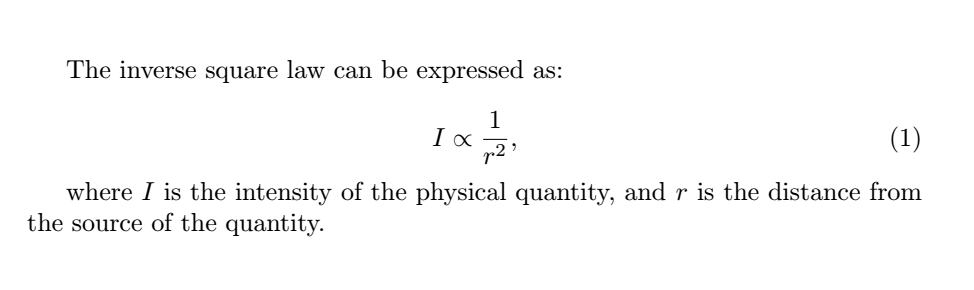
Can you generate Latex code for the inverse square law?Yes, I can certainly help you generate LaTeX code for the inverse square law. The inverse square law describes the relationship between the intensity of a physical quantity and the distance from the source of that quantity. Here’s an example LaTeX code that shows the inverse square law:
\documentclass{article} \usepackage{amsmath}
\begin{document}
The inverse square law can be expressed as:
\begin{equation} I \propto \frac{1}{r^2}, \end{equation}
where $I$ is the intensity of the physical quantity, and $r$ is the distance from the source of the quantity.
\end{document}
In this code, we have used the “equation” environment to create a numbered equation that shows the inverse square law, and we have used the “amsmath” package to display the equation in the proper mathematical format. You can use this code as a starting point and modify it as needed to meet your specific requirements.
I put this code into Latex, and it compiled without any warnings or errors, which is impressive.
ChatGPT has made a huge splash with a lot of hand-wringing in academic circles about how to “overcome” its challenges. Orwellian warnings come to mind, “if people cannot write well, they cannot think well, and if they cannot think well, others will do their thinking for them,” with AI filling in for the role of our thinking. I can’t help to be reminded of when handheld calculators became common (or when spell-checkers became common for a more recent example, or the Grammarly typing assistant for an even more recent example). The initial reaction was to ban calculators from being used in the classroom. (And why did teachers not want us to count on our fingers?) Today this is essentially a non-issue; calculators are there to be used, so long as students understand the underlying process (how to add, subtract, multiply, divide, find roots, use logs and exponents) and the focus has shifted to when and why to use them (and to save time and avoid simple mistakes that can be distracting) as in modeling a word problem with math or how to interpret the result. Ideally, this results in spending less time working out all of the details by hand and more time on the bigger picture of how math can be used. (This might also be comparable to traditional computer programming. It is an extremely useful tool that can save a lot of time and effort, but can make mistakes that we have to be vigilant for.) I can’t help but wonder if AI will become a routine tool to be used in writing, coding, and organizing information, etc. in the future; it already appears to be useful to summarize online information (not that it can’t make mistakes), spark creativity, and help to free us up to shift our focus.
Link
- ChatGPT, https://openai.com/blog/chatgpt/
Leave a Reply