Disclaimer first: Nuclear weapons have horrible destructive power, both in the short and long run. I am in no way trying to make light of or be flippant about the range of serious problems connected to nuclear weapons. My son asked me this question, “could you calculate exactly how far a pizza should be from a nuclear bomb to cook it perfectly”? He likes silly-serious questions and was more interested in how an answer might be estimated. I took it as an opportunity to teach him about the inverse square law in physics and brush up on it myself. My children have been excited about me starting this blog and are following the posts I am making. I have been a bit reluctant to post this here, but he really, really, really wanted me to.
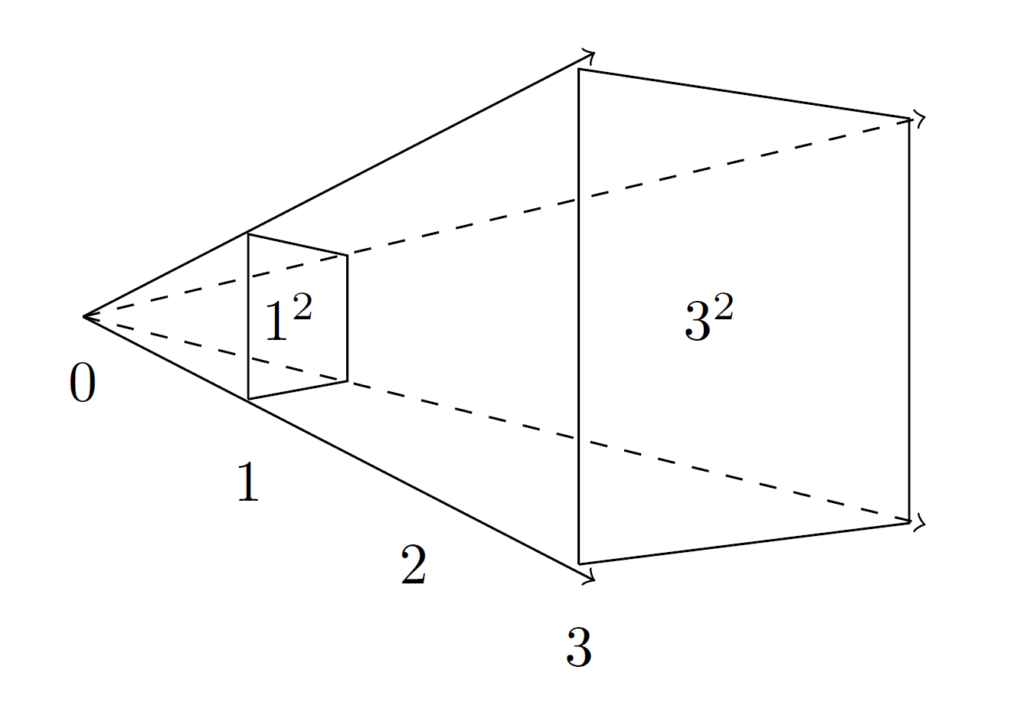
The inverse square law gives the relationship between a starting level of energy and its dilution as it spreads out over space. This is based on the surface area of a sphere which is  .
.
 is the total power radiated from a point source and
  is the intensity at a certain distance
  as the power is spread out over the surface of the expanding sphere.
![\[I = \frac{P}{4\pi r^2}\]](https://floydsplace.us/wpress/wp-content/ql-cache/quicklatex.com-a8ac411f61627a5cfac91568c1774dc0_l3.png "Rendered by QuickLaTeX.com")
We can rearrange this to solve for the distance .
![\[r = \sqrt{\frac{P}{4\pi I}}\]](https://floydsplace.us/wpress/wp-content/ql-cache/quicklatex.com-9cada1d8de169267fa1c981a90e756d2_l3.png "Rendered by QuickLaTeX.com")
So, for example, for the intensity to decline to 1% of its original level
![\[r = \sqrt{\frac{1}{4\pi 0.01}}\approx 2.82\]](https://floydsplace.us/wpress/wp-content/ql-cache/quicklatex.com-3c1fb00fb6fef0b04edd622b867ca913_l3.png "Rendered by QuickLaTeX.com")
The 2.82 is without units of distance. Is it inches, meters, miles, or light-years? The problem is we need a starting distance to calculate the change over units of distance. (Also, working backward, the starting energy is not contained in an infinitely small point; it is generated in a volume of space.)
A different form is used when you have a measure of intensity at a starting distance ( and
and  ) from a point of energy radiation to calculate the intensity at a second point (
 at
at  ).
).
![\[\frac{I_1}{I_2} = \frac{r^2_2}{r^2_1}\]](https://floydsplace.us/wpress/wp-content/ql-cache/quicklatex.com-66f95bcb38f1eb815ad4355aeb9809fa_l3.png "Rendered by QuickLaTeX.com")
This is rearranged to get the second distance
![\[r_2 = \sqrt{\frac{I_1 r^2_1}{I_2}}\]](https://floydsplace.us/wpress/wp-content/ql-cache/quicklatex.com-d98f8c9af06a7d54313acc511b64d589_l3.png "Rendered by QuickLaTeX.com")
One joule of energy can raise 0.239 g of water approximately one degree Celsius.
An average pizza weighs about 200 grams and is mostly dough which is made mostly of water, over 50%. For simplicity, let’s assume the other pizza ingredients have about the same requirements to heat as water. So, it will take  joules to raise the temperature of pizza by one degree.
Room temperature is about 20° C.
Cooking a pizza takes about 450° F or 250° C.
The difference from room temperature is 230° C.
So, it would take  .
.
The diameter of a medium pizza is about a foot or 0.3048 meters.
The area of a circle is  so the area of a pizza is
  .
.
A ton, 2000 pounds, of TNT releases 4.184 gigajoules.
Giga- is  so this is
  joules.
So, at what distance will a ton of TNT (approximately) cook a pizza?
A ton of TNT takes up a volume. Let’s say it results in a cube (with six sides) of energy with the center of the faces one meter away from the center with
![\[\frac{4.184 \times 10^9}{6} \approx 0.697 \times 10^9\]](https://floydsplace.us/wpress/wp-content/ql-cache/quicklatex.com-c117891bbaa9d5c16f66d1fed214fb4e_l3.png "Rendered by QuickLaTeX.com")
joules of energy per face.
The area of a face is  .
.
A pizza’s area fraction of this face is 
So, there would be  per pizza.
Now we can use the second equation.
![\[r_2 = \sqrt{\frac{5 \times 10^7 J 1m^2}{11,000 J}} \approx 67.4m\]](https://floydsplace.us/wpress/wp-content/ql-cache/quicklatex.com-c7a6aeb3b29394eb9a1c8819b94671e2_l3.png "Rendered by QuickLaTeX.com")
The vast majority of energy is not transferred to the pizza. (We are also sidestepping several other issues, such as the time of exposure to heat and effects of the ground surface, to keep this simple.)
So, we can modify this using a fraction (10%).
![\[r_2 = \sqrt{\frac{0.1 \times 5 \times 10^7 J 1m^2}{11,000 J}} \approx 21.3m\]](https://floydsplace.us/wpress/wp-content/ql-cache/quicklatex.com-f18f6bb126d5b1724b358b2cb9f9c4f0_l3.png "Rendered by QuickLaTeX.com")
Next is to scale this up to kilotons or megatons of TNT released by nuclear explosions.
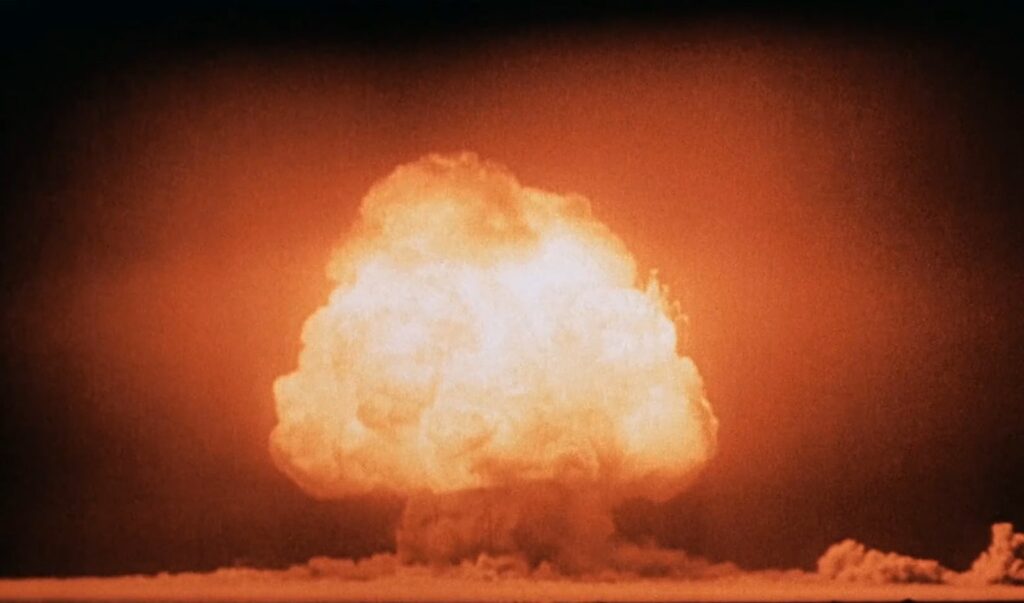
Trinity (1945) was the first test of a nuclear weapon and yielded 25 kt (kilo-tons) of TNT equivalent.
![\[r_2 = \sqrt{\frac{25,000\times0.1 \times 5 \times 10^7 J 1m^2}{11,000 J}} \approx 3.3km\]](https://floydsplace.us/wpress/wp-content/ql-cache/quicklatex.com-56ab3bfde08a97ea1a27e1fe41ea03fc_l3.png "Rendered by QuickLaTeX.com")
or 2 miles (using 10% of the energy).
If only 1% of the energy were transferred to heat to cook the pizza, then
![\[r_2 = \sqrt{\frac{25,000\times0.01 \times 5 \times 10^7 J 1m^2}{11,000 J}} \approx 1km\]](https://floydsplace.us/wpress/wp-content/ql-cache/quicklatex.com-05ae0f586a87892fc0e3cf2196e11abe_l3.png "Rendered by QuickLaTeX.com")
or 0.6 of a mile.
Tsar Bomba (1961) was the largest nuclear explosion and had a yield of 50 Mt (mega-tons) of TNT.
![\[r_2 = \sqrt{\frac{50,000,000\times0.1 \times 5 \times 10^7 J 1m^2}{11,000 J}} \approx 151km\]](https://floydsplace.us/wpress/wp-content/ql-cache/quicklatex.com-6161da01aa8d17da15526b662b58d523_l3.png "Rendered by QuickLaTeX.com")
or 94 miles.
If, on the other hand, only 1% of the energy was transferred to cooking the pizza (at longer distances, we should factor in the absorption of energy by the atmosphere and similar factors),
![\[r_2 = \sqrt{\frac{50,000,000\times0.01 \times 5 \times 10^7 J 1m^2}{11,000 J}} \approx 47.7km\]](https://floydsplace.us/wpress/wp-content/ql-cache/quicklatex.com-1374fff7ea08a3c7b9bb5a84dd625af1_l3.png "Rendered by QuickLaTeX.com")
or 29.6 miles.
So, in summary, we have a range estimate of 0.6 to 2 miles at the lower end and 30 to 94 miles at the upper end, depending on the yield of the explosion.
Again, this is a very, very rough estimate with a lot of simplifying assumptions just to illustrate how the inverse square law could be used to approach the question.
I also tried OpenAI ChatGPT and got this response.
How far should a pizza be from a nuclear explosion to cook it perfectly?It is not advisable to use a nuclear explosion to cook a pizza or any other food. Nuclear explosions are extremely destructive and pose a serious risk to human health and safety. They produce intense heat, light, and radiation, and can cause severe damage to buildings, infrastructure, and the environment. In addition, the radioactive fallout produced by a nuclear explosion can have long-term health effects on those exposed to it.
This is a much more sensible answer than the one I came up with.
While we’re on this topic, it’s worth pointing out that there actually were some ridiculous uses of nuclear weapons that were proposed. Project Plowshare is an example. It is a reference to Isaiah 2:4, “they shall beat their swords into plowshares, and their spears into pruning hooks; nation shall not lift up sword against nation, neither shall they learn war any more” and Micah 4:3. Projects such as excavating canals, harbors, road cuts through mountains, connecting aquifers, and assisting with mining and oil extraction were thought of. Fortunately, the project was ended in 1977.
Links
- Wikipedia article on the inverse square law, https://en.wikipedia.org/wiki/Inverse-square_law
- Wikipedia article on the Trinity test, https://en.wikipedia.org/wiki/Trinity_(nuclear_test)
- Wikipedia article on the Tsar Bomba test, https://en.wikipedia.org/wiki/Tsar_Bomba
- Wikipedia article on Project Plowshare, https://en.wikipedia.org/wiki/Project_Plowshare
Media
- Image of the Trinity mushroom cloud, https://commons.wikimedia.org/wiki/File:Trinity_Detonation_T%26B.jpg

Leave a Reply