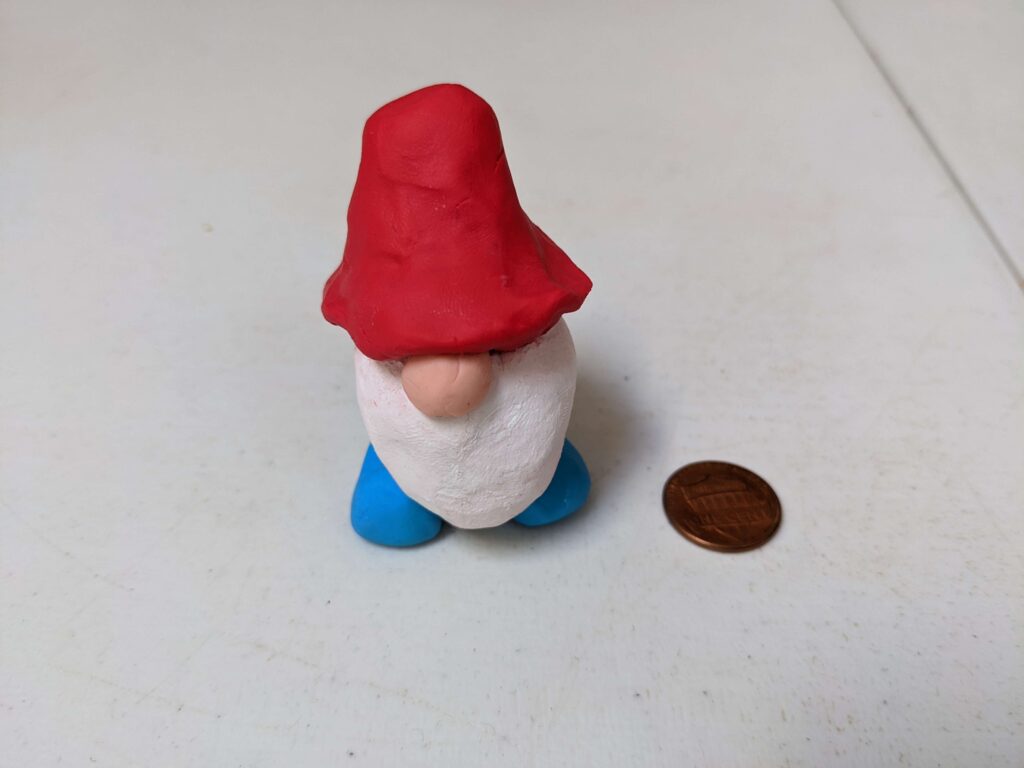
We were playing with making some objects out of polymer clay, and I liked how this small gnome turned out. I’ve got him standing over the corner of my desk while writing this. It was very simple and easy to make, essentially five balls of clay stuck together. There was a temptation to add more details, but sometimes simpler is better to draw in the viewer’s imagination to supply details.
The “clay” is PVC (PolyVinyl Chloride, as is used in a lot of plastic drain pipes), and I hardened it by preheating and baking it for 20 minutes.
This got me thinking, where did gnomes, in general, and as a decoration, most commonly garden gnomes, come from? Today they seemed to be tied up in the concept of pink flamingos, which is a bit ironic when you get into their history. I looked up some information, and frankly, it quickly gets confusing. Cultures all around the world have traditions about diminutive hidden folk. Examples include Cherokee Yunwi Tsunsdi, Fon Aziza, Hawaiian Menehune, and Iroquois Jogah. In Europe, the history of gnomes seems to blur into myths about goblins, brownies, and dwarfs in northwestern Europe. Going back some more, I ran into erdgeists (earth spirit) and kobolds in Germany and cofgods (a household god, literally “cove-god”) in Anglo-Saxon tradition. The English-Scottish borderlands seem to be especially rich with hobs (the inspiration for Tolkien’s Hobbits) and redcaps. Redcap is interesting because many gnomes today, including this one, have a red hat (which may just be a coincidence). However, most traditions of redcap are much more sinister; the cap was dyed with the blood of his victims.
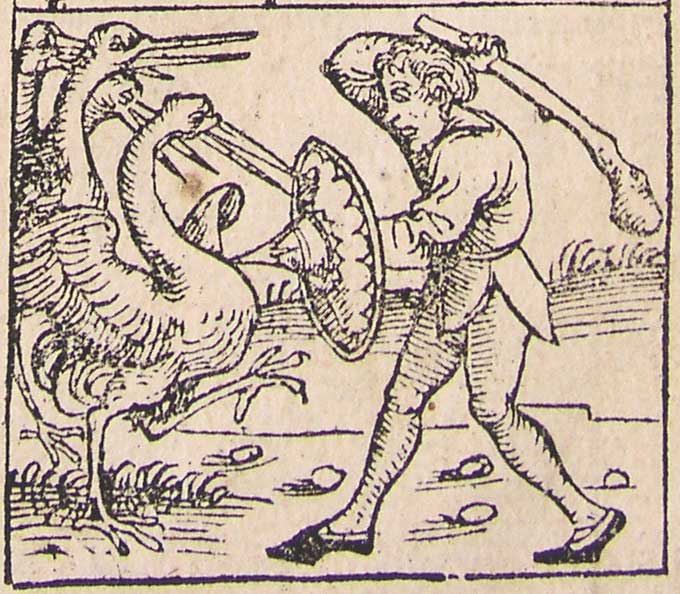
An (or the) early reference that specifically mentions gnomes is Paracelsus’ (1566) A Book on Nymphs, Sylphs, Pygmies, and Salamanders, and on the Other Spirits, with the gnomi as an elemental earth spirit. They may even trace back, in part, to the ancient Greek Pygmies that lived in underground caves and had an endless war with cranes (thus the irony in the modern garden gnome and pink flamingo pairing). One curious detail that I came across is that the word gnome can be a masculine version; female gnomes can be known as gnomids. (I say “can be” because, as with many things about gnomes, it doesn’t appear to be well established.) Another new word that I came across is chthonic (inhabiting the underworld or associated with earth and soil).
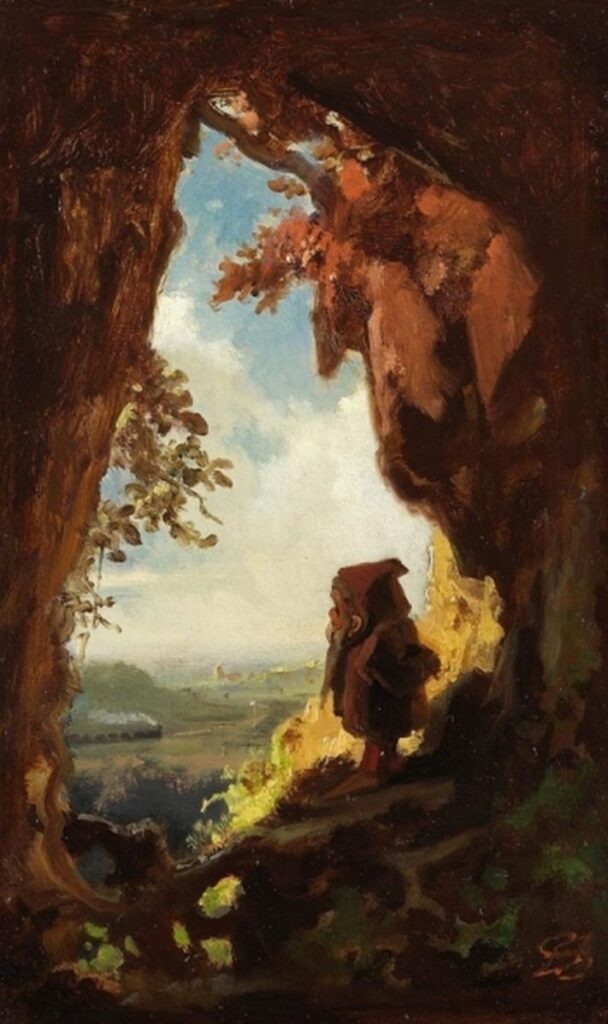
The more modern idea of a garden gnome seems to be German in origin, an offshoot of 19th-century Romanticism, but quickly moved to English gardens. In the 1800s terracotta garden gnomes (Gartenzwerg) were produced in Thuringia, which quickly made their way to English gardens. Eventually, these came to the US where garden gnome sculptures seem to have taken off after World War II.
Gnomes seemed to evolve over thousands of years from a complex and obscure web of origins, with the input of a wide range of supernatural creatures from different cultures that were both sinister and beneficial, or simply indifferent, into the modern concept of a humble earthy (chthonic!) gnome. Things seemed to settle down and make sense—but in the late 1990s and early 2000s, they quickly got strange again.
Gnomes rebelled from patiently standing by in gardens and started traveling. There were several famous cases in the media of gnome kidnappings and gnome travel. There was even a Gnome Liberation Front that was active in France and Italy. Some of these gnomes eventually returned to their home gardens, but there is also a gnome reserve that has been established in West Putford, Devon, England, where you can see gnomes arranged peacefully interacting with each other. I might look up one day, and this gnome will suddenly be gone from my desk to travel the world, hang out in a gnome reserve, or both.
Links:
- Wikipedia article on polymer clay, https://en.wikipedia.org/wiki/Polymer_clay
- Polymer clay kit for sale on Amazon.com, https://www.amazon.com/Polymer-Starter-Modeling-Sculpting-Accessories/dp/B07F68L2DW
- Wikipedia article on PVC plastic, https://en.wikipedia.org/wiki/Polyvinyl_chloride
- Wikipedia article on gnomes, https://en.wikipedia.org/wiki/Gnome
- Wikipedia article on garden gnomes, https://en.wikipedia.org/wiki/Garden_gnome
- Gnome-related historical links:
- Wikipedia article on Cherokee “fairies” and little people, https://en.wikipedia.org/wiki/N%C3%BB%C3%B1n%C3%AB%27h%C3%AF
- Wikipedia article on Hawaiian Menehune, https://en.wikipedia.org/wiki/Menehune
- Wikipedia article on the Fon Aziza, https://en.wikipedia.org/wiki/Aziza_(African_mythology)
- Wikipedia article on the Iroquois Jogah, https://en.wikipedia.org/wiki/Jogah
- Wikipedia article on Brownies, https://en.wikipedia.org/wiki/Brownie_(folklore)
- Wikipedia article on cofgods, https://en.wikipedia.org/wiki/Cofgod
- Wikipedia article on dwarves, https://en.wikipedia.org/wiki/Dwarf_(folklore)
- Wikipedia article on erdgeists, https://en.wikipedia.org/wiki/Erdgeist
- Wikipedia article on goblins, https://en.wikipedia.org/wiki/Goblin
- Wikipedia article on hobs, https://en.wikipedia.org/wiki/Hob_(folklore)
- Paracelsus (1566) A Book on Nymphs, Sylphs, Pygmies, and Salamanders, and on the Other Spirits, In
- Wikipedia article, https://en.wikipedia.org/wiki/A_Book_on_Nymphs,_Sylphs,_Pygmies,_and_Salamanders,_and_on_the_Other_Spirits
- p.231 on Google Books, https://books.google.com/books?id=YIKLKqwsEc0C&pg=PA213#v=onepage&q&f=false, Sigherist, Henry E. (ed.). Four Treatises of Theophrastus von Hohenheim Called Paracelsus. Baltimore and London: Johns Hopkins University Press. pp. 213–254. ISBN 0-8018-5523-3.
- Wikipedia article on Greek Pygmies, https://en.wikipedia.org/wiki/Pygmy_(Greek_mythology)
- Wikipedia article on redcaps, https://en.wikipedia.org/wiki/Redcap
- A series of 2018 blog posts by Eric Forcier about the history of garden gnomes, http://ericforcier.ca/a-fascination-with-gnomes-introduction/
- A BBC article on garden gnomes, https://www.bbc.com/news/magazine-22594835
- Garden Gnomes: A History, 2009, by Twigs Way, Bloomsbury Publishing
- Wikipedia article on Romanticism, https://en.wikipedia.org/wiki/Romanticism
- Traveling gnome links
- Wikipedia article on traveling gnomes, https://en.wikipedia.org/wiki/Travelling_gnome
- Wikipedia article on the 2001 movie Amélie (which I have not seen) that features a traveling gnome, https://en.wikipedia.org/wiki/Am%C3%A9lie
- A 2016 Toronto Star article about a traveling gnome, https://www.thestar.com/news/canada/2016/08/03/roaming-gnome-is-home-complete-with-photo-album-and-a-name.html
- A Mirror article about garden gnomes, https://www.mirror.co.uk/news/uk-news/the-shadowy-world-of-the-sinister-gnome-liberation-326762
- A page about the Garden Gnome Liberation Front, https://www.cs.mcgill.ca/~rwest/wikispeedia/wpcd/wp/g/Garden_Gnome_Liberation_Front.htm
- Page about a gnome sanctuary in Italy, https://www.barganews.com/gnomes/
- A page about a gnome theft at Davenport College, https://ourdavenport.com/2017/03/06/throwback-monday-a-gnome-origin-story/
- Wikipedia article about the English gnome reserve, https://en.wikipedia.org/wiki/Gnome_Reserve
- A gnome riding a flamingo for your garden, https://www.amazon.com/Funny-Guy-Mugs-Garden-Statue/dp/B07KYW1D15
- A guidebook for surviving a turn for the worse, https://www.amazon.com/How-Survive-Garden-Gnome-Attack/dp/158008463X
Wordlist
- Chthonic—inhabiting the underworld or associated with earth and soil.
- Hob—A diminutive form of Robin, which is a diminutive of Robert. So the Hobbits could actually be Robertses in the Gollum dialect.
Media
- Image of a Pygmy fighting cranes (Hartmann Schedel, 1493, Nuremberg Chronicle), https://commons.wikimedia.org/wiki/File:Nuremberg_chronicles_-Strange_People–Pygmy(XIIr).jpg
- Image of a painting by Carl Spitzweg, Gnome Watching Railway Train (circa 1848), https://commons.wikimedia.org/wiki/File:CarlSpitzwegGnomEisenbahnbetrachtend.jpg


.jpg)

Leave a Reply