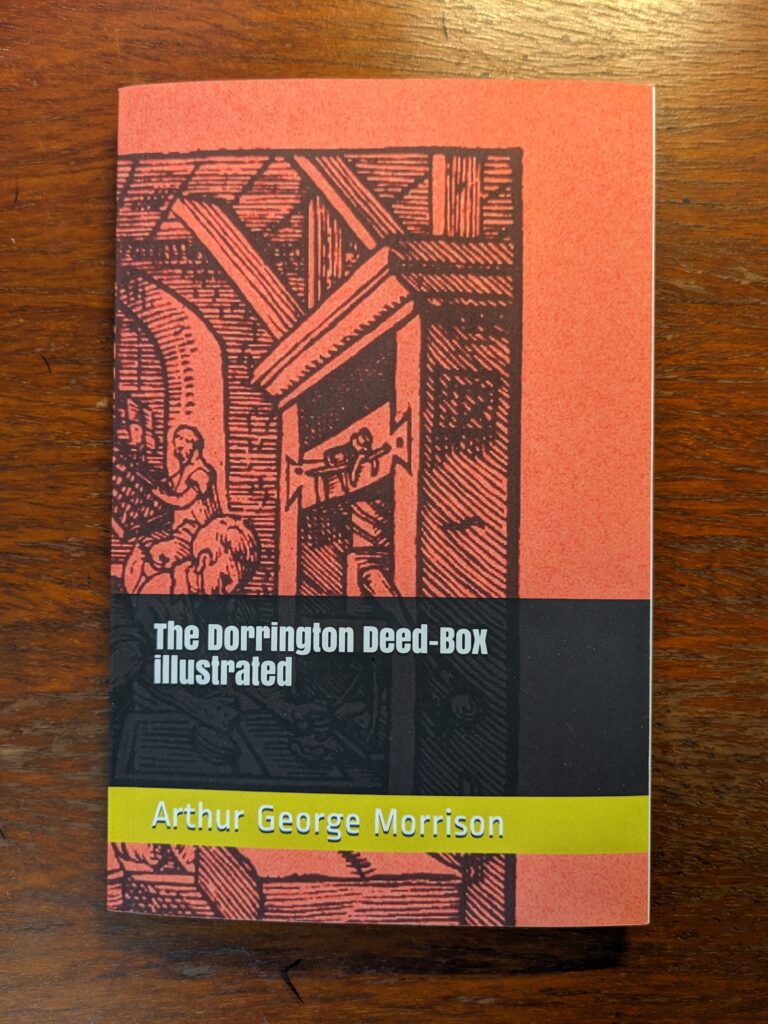
I recently finished The Dorrington Deed-Box (1897) by Arthur Morrison. It is a fluffy, easy-to-read book that will not change your life. I could see it as something to bring along to read as a diversion while on a trip or on vacation. It is written kind of like a Sherlock-Holms-type mystery, but it is not really a mystery book, more of a discovery of a record of crimes. It is a collection of six short stories and contains a nice twist in the initial part, but after that, it might become tedious if you took it too seriously. In the Holms style, plans have a way of working out too easily, and people have a bit too much relevant knowledge about or are strangely prepared for things that come up.
Wordlist
- As it were—to indicate a statement is literally incorrect and to accept the implied meaning. This can be used with idioms that are in a less standard context, such as “the older dog took the puppy under its wing as it were”, or simply to indicate an idiom is being used. Honestly, I am not sure this phrase does appear in the book, but for some reason I had written it down as a reminder to double-check the exact meaning.
- Bottle of bass—a bottle of beer from Bass Brewery.
- Brocade—a fabric with a pattern woven into it. This word also came up recently in my list for World Without End. Eventually, I will get it.
- Codicil—an amendment to a will.
- Covetousness—a greedy desire for money or possessions others have.
- Crepe-hair—braided artificial hair. Maybe related to the word crêpe for folded.
- Discursive—rambling, moving between topics. It apparently can also mean a thoughtful well organized argument. This is an example of a contranym (or auto-antonym) which are rare words that simultaneously have their own opposite definitions.
- Equivocation—purposely being ambiguous. (Imagine the problem of a discursive equivocation!)
- Faience—a form of glazed ceramics.
- Hachiman—a Shinto god of archery and war that was also included in Japanese Buddhism (see Shinbutsu-shūgō).
- Hansom—a two-wheeled horse-drawn carriage.
- Humbug—a deception.
- Indisposed—unwilling (in addition to the sense of being unwell).
- Lascar—a sailor from some of the lands around the Indian Ocean.
- Lustres—a coating containing metal used in some ceramic glazes.
- Loo tables—a round-topped folding card table named after the loo card game (the game is also known as lanterloo).
- Muntin—a supporting bar between panes of glass.
- Obdurate—stubborn and refusing to change one’s mind.
- Organ-grinder—a type of street musician that also became a derogatory Italian immigrant stereotype.
- Peach-bloom—a Western term for a type of Chinese ceramic glaze.
- Pecuniary—related to money.
- Prepossessing—appealing appearance.
- Pilaster—a square column that is attached to and projects along a wall.
- Plunger—a hasty and reckless person (in addition to the plumbing tool definition).
- Politic—shrewd, pragmatic, tactful, acting appropriately under the conditions.
- Publican—the manager of a pub.
- Punctilio—a petty procedure.
- Pungent—used to describe a sharp, biting criticism (to describe a remark in addition to the smell and taste definition).
- Ramp / ramped—to drive up the price of something.
- Rigmarole—a long rambling complicated story or process. I knew this word but wrote it down because I was curious about its origin. It might come from Middle English and be related to the roll of charges that are read at court about someone accused of a crime.
- Rum—strange (when used as an adjective).
- Seedy—run down and shabby. It may have come from a description of flowers that are past their peak and “gone to seed”.
- Soho—an entertainment district in London’s West End (in addition to the “South of Houston Street” Manhattan district).
- Soi-disant—so-called, claimed by a person about themselves, but the claim is not generally shared by others.
- Stokers—people that tend a furnace.
- Tout—aggressively selling something.
- Usurer—a money lender with a high interest rate, a loan shark.
- Welshing—an offensive term (as an insult against Welsh people) for not doing something you agreed to.
Links
- Freely available text online, https://www.gutenberg.org/cache/epub/53341/pg53341-images.html
- Wikipedia article, https://en.wikipedia.org/wiki/The_Dorrington_Deed-Box
- Amazon.com link, https://www.amazon.com/dp/B08XLP7RHG. The title on this version of the book says “illustrated”, but this edition of the book is not illustrated.
- Wikipedia article about the author, https://en.wikipedia.org/wiki/Arthur_Morrison
- Lacquerware is discussed in one of the short stories which contains a lot of unfamiliar terms (the author Arthur Morrison collected Japanese art), and I am including a link to a Wikipedia article about it, https://en.wikipedia.org/wiki/Lacquerware
Leave a Reply