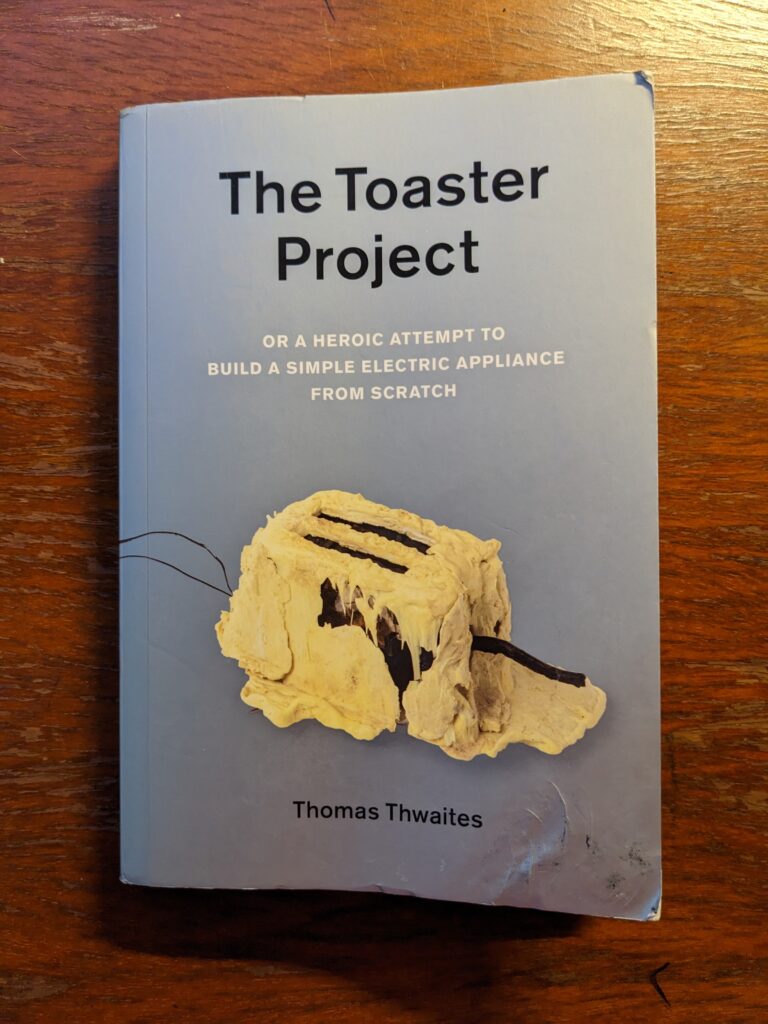
Excellent! This book, The Toaster Project (2011) by Thomas Thwaites, is about something I have thought about for decades. How do we make the things that we have around us? Not just putting it together from a kit but how are the parts actually made, and the tools to make the parts, and the tools to make the tools, all the way back to the very beginning. When you take some time to think about it, a tremendous web of materials and specialized methods that spans the globe expands behind everyday objects—and how are they so cheap? There is a sense of massive scale behind things that goes way beyond an individual’s abilities. Just think about how you are able to read these words right now.
To quote the author
The point at which it stopped being possible for us to make the things that surround us is long past. Well, that’s what it feels like, but is it?
p. 15
Thwaites buys a regular cheap (£3.94/$6.10) toaster for sale and takes it apart. He picks a toaster because it is kind of a silly thing that none of us needs, but many of us have.
In terms of toasters, if everyone else has a toaster and I don’t, well, I’ll feel a bit deprived, and I’ll go buy a toaster if I can afford it. The fact that wealth is relative is, I think, one thing that drives the economy. It’s not that people have “infinite wants” (as economists traditionally claim), just that no one wants to be at the poor end of the scale.
p. 174
What goes into making this toaster? He takes it apart into 157 parts, but then a lot of these can be subdivided for a total of 404 “bits”. The most important materials that he needs are steel, mica, plastic, copper, and nickel, which is how the rest of the book is organized. He talks to a lot of people to learn how to make the materials. Along the way, he runs into people who want to help him learn and communicate more about their area of specialty and, one gets the feeling, to see something, anything, made from materials mined within the country again.
I talked to some people about the book while reading it, and many seem to stubbornly completely miss the point at the get-go. The point is not to make toast; it’s to make the toaster. If he wanted to make toast, he could just use a stick and a fire. Thwaites wants to understand part of what is really behind cheap common commercial objects.
He is quickly faced with the impossibility of the project and has to make a series of pragmatic exceptions, still learning more about the true depth of what is involved. Ignoring the fate of his mother’s microwave, steel was accomplished surprisingly “easily”. Plastic becomes a real wall, with the realization that there may be reasons that we had an iron age long before the plastic age. There is an amusing exchange he has with an oil company trying to source some crude oil to refine at home. He is advised by others that he can just use metal for the case, but again that is not the point. He wants to see just how hard it is to make something approximating that toaster. After all, a “plastic case is the defining feature of mass-produced consumer goods” (p. 102).
He has to “cheat” and start cutting corners; still, in the end, it cost him £1187.54/$1837.36 over nine months to make a £3.94/$6.10 toaster one can buy in less than an hour (illustrating economies of scale and specialization/”division of labor”). In reading more about the author, he seems to be wonderfully tolerant of naysayers. I would be tempted to say, “make your own toaster first, and then we’ll talk”, but he doesn’t do this.
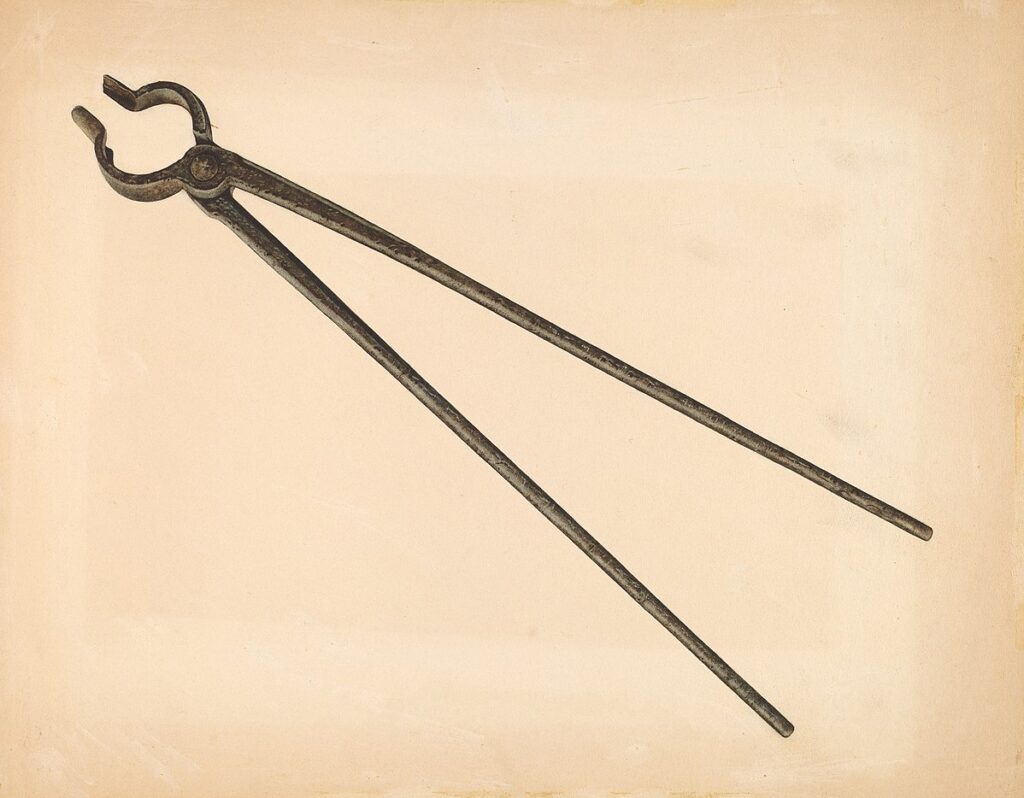
This book reminds me of a passage in another book, the 11th-century (?, I’m not sure about the date) Pirkei Avot (פִּרְקֵי אָבוֹת) “Chapters of the Fathers”. Tongs are a centrally important blacksmithing tool. The metal has to be hot to work it into shape. We need metal tongs to hold the hot metal. One of the things a blacksmith learns is how to make his or her own tools. A trained blacksmith is somewhat self-sufficient, but you need tongs to make tongs. So, how were the first tongs made? One resolution to this apparent paradox is that God made the first tongs, the Tong of Tongs. “Ten things were created at twilight of Shabbat eve. These are: […] as well as the original tongs, for tongs are made with tongs.” (Pirkei Avot 5:6). We have a high degree, an understatement, of dependence on prior tools. Our cycles of production are removed from the first steps and have become dependent upon themselves. How well could we really be able to rebuild everything from scratch if we had to? How would we rebuild all of the power station transformers after a Carrington-Event-type solar flare—without electricity—for example? Needing electricity to repair substations is a modern version of the tong paradox.
I am confident that we could eventually rebuild from scratch, but do we have a good idea of how difficult it would be? Especially considering that all of the easily available high-quality ore has been mined. We would recycle materials from the objects around us, but how much of the metal, for example, has been lost to rust that is spread thinly over the surface of the Earth? All of the easily available cheap energy from fossil fuels has been extracted, and the carbon, unfortunately, has been spread around the Earth. Could landfills become highly valuable in the future and intensively mined? (I sense a goofy science fiction plot developing, “The Lords of the Landfills”.) This goes beyond survival and prepping on an individual level. Some thought along these lines leads to a disturbing suspicion that, as a global economy, we may be in a more precarious situation than we realize, with some aspects of hypothetical rebuilding being possibly more difficult than what our ancestors did (and, of course, some aspects much easier). There has been a lot of interest in individual-level hunter-gatherer style survival skills and home gardening/farming/hunting type skills, but what about the in-between specialized manufacturing skills over the last thousands of years that we no longer do and tend to be overlooked, not to mention lost collective institutional-type knowledge? Imagine how the cost of things would shoot up orders of magnitude with the loss of economies of scale and specialization during a catastrophic rebuilding event.
Speaking of science fiction with circular technology dependence, one of the plot elements of Lucifer’s Hammer (1977) by Larry Niven and Jerry Pournelle is the struggle to keep a power station running to supply electricity to keep the station running. Once the station shuts down, it cannot be restarted because there would no longer be any electricity to run it.
This falls into wild speculation, but the question is important enough to brainstorm about it a bit (which generates some more science fiction plot ideas). Might it not take an external Carrington Event (as just one example of many possible external scenarios, or combinations of scenarios (pandemic, rapid climate change, asteroid impact (low probability), near-Earth supernova (extremely low probability), and things we’re not thinking of), to choose from) to break our world economy, but could we slowly fall into the stress of a lack of easy resources and the need to fall back in our production of materials from subtle economic pressures (possibly including regulation stemming from good intent) that are unrecognized at the moment? Could there be lurking complex economic analogs of the Kessler syndrome (where a problem can remain hidden and then suddenly cascade, nuclear war is the obvious one, but what about interactions of climate effects, declining material quality, human health, technological training, energy expense, chemical pollution, and all the things that don’t come to mind and propagate in a chain reaction) or the “error catastrophe” (where the information contained in something is needed to make that thing, computing systems for instance, and there is an accumulating copying error, including perhaps malicious error such as computer viruses, or simply misinformation and a loss of information) that are unrecognized at the moment but can suddenly self-feedback, interact, and manifest themselves when economic thresholds are passed? (I can’t help thinking of “blighted zones” and the increasingly difficult issues of sourcing production materials in the 1957 Atlas Shrugged, but let’s sidestep that and not get caught up in Ayn Rand’s philosophical issues.)
Aside from this dramatic economic doomsday scenario pondering, there is also the very real ecological issue of waste with a tragedy of the commons and the larger cost, beyond what you see in the store, of producing these cheap goods, which the author goes into in the book. Here is just one quote that stood out to me:
Differing legeslative environments are why the same company can operate both the world’s dirtiest nickle smelter in Siberia and one of the cleanest in Finland.
p. 175
There is also the humanitarian issue of how people are paid and supported that make these goods in light of how cheap they are for us to buy.
My attempt to make a toaster has shown me just how reliant we are on everyone else in the world. Though there’s romance in that idea of self-sufficiency and living off the land, that’s also an absurdity. There is no turning back the clock to simpler times—not without mass starvation anyway. Besides the majority of the world is still trying to turn the clock forward.
pp. 175–176
Entire books can and have been written about the issues of economic imbalances and the degree to which the lifestyles of some people are dependent on the different economic situations of other people.
However, not to devolve into blanketly negative perspectives, I have tried to really make things from time to time, it is fun to take on the challenge, and one learns a lot in the process. Also, wouldn’t it be both fun and informative if there was a code on the finished product that could be scanned to show you the, at least abstracted, supply chain used to create it? Maybe a company could start a product line with this as a selling point?
It is sobering to think about just why it is so awe-inspiring when someone actually does make something from scratch. There are whole YouTube channels built around this. I am not in any way criticizing the people that do this; I am all for it and try this myself from time to time. But I find it a bit fascinating to realize that we have changed so much culturally that the simple act of really making something is a wonder.
Reading this book is refreshing because it is written in a plain-spoken, straightforward, and very honest manner. You can feel the author’s naive eagerness to take on something that is far larger than he realizes, with a sense of humor that enjoys the absurd (e.g., choosing a toaster for this project in the first place) throughout the process. It is easy to read in a short amount of time, but it contains ideas that generate a lot of thought. I highly recommend it.

After writing this post, I came across I, Pencil (1958) by Leonard Read while looking up the links added at the end. It is short and available online. This essay touches on several of the ideas discussed above. In summary, a vast number of people are involved in making a pencil, which you can easily buy at the store and take for granted, but, surprisingly and only realized after some thought, no single person knows completely how the pencils for sale in the store are made. Yet, the system works, and we can buy pencils—an example of the “invisible hand” idea in economics, which also comes up in Thwaites’ book. Of course, almost anyone can make a workable pencil, but how are the pencils in the store actually made in the full sense of the word, all the way back to the individual components and the tools to make those components?
Links
- The Toaster Project (2011) by Thomas Thwaites
- The book for sale on Amazon.com, https://www.amazon.com/dp/B00ANYWFP6
- Wikipedia article about the author, https://en.wikipedia.org/wiki/Thomas_Thwaites_(designer)
- The Toaster Project page on the author’s personal website, https://www.thomasthwaites.com/the-toaster-project/
- The Toaster Project website, http://www.thetoasterproject.org/page2.htm
- Wikipedia article about economies of scale, https://en.wikipedia.org/wiki/Economies_of_scale
- Wikipedia article about the division of labor (economic specialization), https://en.wikipedia.org/wiki/Division_of_labour
- Pirkei Avot
- Wikipedia article about the Pirkei Avot, https://en.wikipedia.org/wiki/Pirkei_Avot
- English translation of the Pirkei Avot, https://www.chabad.org/library/article_cdo/aid/5708/jewish/Ethics-of-the-Fathers-in-English-and-Hebrew.htm
- Wikipedia article about the Carrington Event, an 1859 solar flare, https://en.wikipedia.org/wiki/Carrington_Event
- Wikipedia article about Lucifer’s Hammer (1977) by Larry Niven and Jerry Pournelle, a fictional future about a major asteroid impact, https://en.wikipedia.org/wiki/Lucifer%27s_Hammer
- Wikipedia article about the Kessler syndrome, a hypothesized problem related to the density of objects in low Earth orbit, https://en.wikipedia.org/wiki/Kessler_syndrome
- Wikipedia article about the idea of an error catastrophe in biological systems, https://en.wikipedia.org/wiki/Error_catastrophe
- Wikipedia article about Atlas Shrugged (1957) by Ayn Rand, https://en.wikipedia.org/wiki/Atlas_Shrugged
- Wikipedia article about the tragedy of the commons, https://en.wikipedia.org/wiki/Tragedy_of_the_commons
- How to Make Everything channel on YouTube by Andy, https://www.youtube.com/channel/UCfIqCzQJXvYj9ssCoHq327g
- I, Pencil (1958) by Leonard Read
- Wikipedia article about I, Pencil, https://en.wikipedia.org/wiki/I,_Pencil
- Text available online, https://www.econlib.org/library/Essays/rdPncl.html?chapter_num=2#book-reader
- Wikipedia article about the invisible hand idea in economics, https://en.wikipedia.org/wiki/Invisible_hand
Wordlist (Most of the vocabulary used is generally quite basic. I have a chemistry background that helped me to be familiar with some of the rarer terms that came up, but I did make a note to take a closer look at the definition of a few of the words used.):
- Boiler suits—coveralls. A work outfit that covers the whole body except for the head, hands, and feet.
- Honky-looking—”strange looking” from the context. Perhaps he meant wonky-looking?
- Pendant—a person that is overly concerned with minor details. I keep running into this and pedantic, but they are not words I regularly use myself. I keep noting them to force myself to get familiar with the term. Does this make me a pedantic pendant?—just practicing.
- Phantasmagoria—a sequence of images like in a dream.
Media
- Blacksmith’s Tongs (1942) by Orison Daeda, in the Index of American Design by the National Gallery of Art, accession number 1943.8.8725, https://commons.wikimedia.org/wiki/File:Orison_Daeda,_Blacksmith%27s_Tongs,_c._1942,_NGA_20922.jpg https://www.nga.gov/collection/art-object-page.20922.html
- A photo of a pencil (2010) by Charm on Wikimedia Commons, https://commons.wikimedia.org/wiki/File:Pencil-db.jpg

Leave a Reply