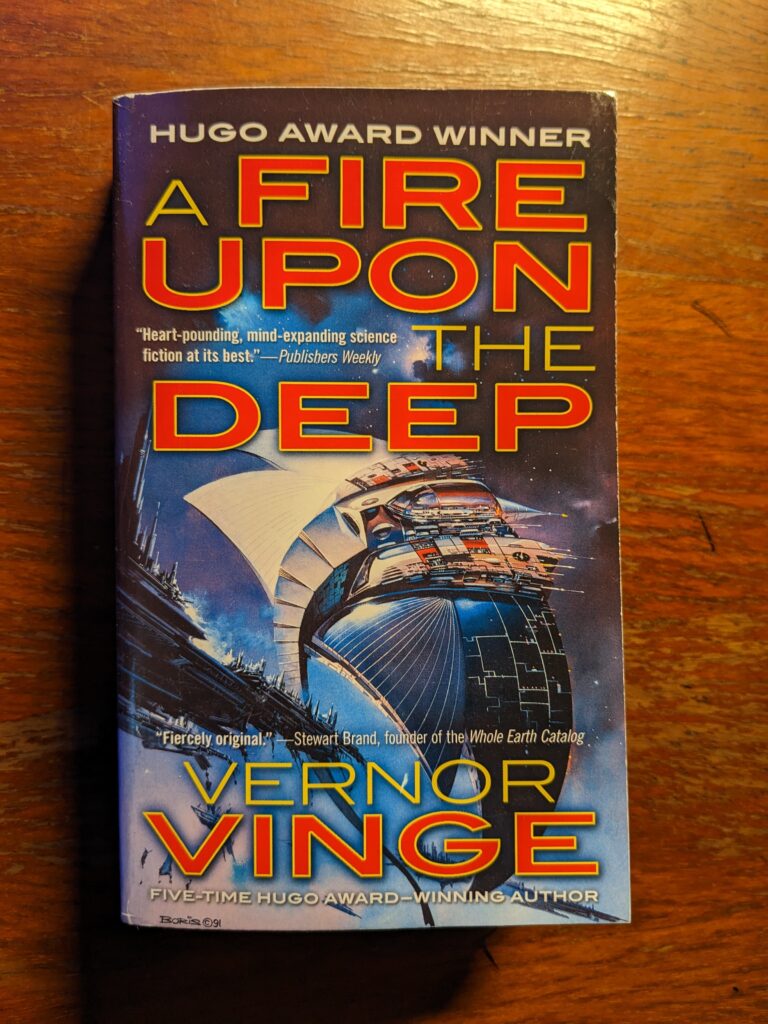
I just finished reading A Fire Upon the Deep (1992) by Vernor Vinge. I was curious about it because it was highly recommended, but I also (purposefully) didn’t know much about it to avoid spoilers. This contained a lot of aspects of the classic Western space opera, where an individual (possibly with superhero abilities) or small group of individuals boldly sets out to save the day on their own in a dramatic fashion. I intend the use of Western as a double meaning, both as an outcome of modern individualistic Western culture and for the similarities to classic movie Westerns, but set in space. (However, in stricter current literature categories, this is much more of a space opera than a space Western.)
It does have fantasy elements that do not place it in the hard science fiction category. However, this book is exceptionally creative in terms of the “world” building. Rather, I should say galaxy building. The galaxy is a structured, complex place and not just a hodgepodge collection of stars, planets, and civilizations. There are also two other species that figure prominently in the story, and the author clearly put a lot of thought into how to design original alien intelligences. Coincidentally, it touches on some points that I explored in a previous post about Children of Memory regarding levels of intelligence, different ways to be intelligent, and if an individual is real or not. I’ll have to stop there to avoid getting into spoiler territory. The book, written in 1992, also anticipated issues of misinformation that have come more to the forefront on the internet in recent years. I’m putting this one in the recommended category.
A minor note, but I wanted to mention the use of “letters” at the ends of the chapters that shift, add to, or broaden the perspective. This reminds me of how letters were used in Artemis, which was written later. I’m making a mental note to keep a lookout for the use of this type of writing device.
Links:
Wordlist (draft to be updated)
- Aborning—during birth or while being created.
- Actinic—intense light that can burn or cause chemical reactions. Light that includes high-energy ultraviolet light.
- Adroit—clever and/or skillful.
- Alarums—old-fashioned term for alarm.
- Antercedant—something that precedes another.
- Armiphlage—I am unsure about this one and the next. I can’t seem to find a definition. Update: This, along with clenirations are made-up words. I found a mention of it here, https://tropedia.fandom.com/wiki/Perfectly_Cromulent_Word
- Cannines—I may have made a copying error on this one. It is possibly canniness, showing exceptional judgment.
- Cantilever—a structural element that projects horizontally and is attached at one end.
- Caroming—to hit and rebound off of something.
- Clerestory—The upper part of a large church that contains a row of smaller windows.
- Dilettante—someone with a superficial interest in a topic.
- Dirges—a mournful song or lamentation.
- Embrasure—an opening in a wall that is wider on the inside than the outside, usually for a defensive position.
- Evanescent—transient; only appears for a moment and then disappears again.
- Flenser—a person that strips off skin from an animal or cuts blubber from a whale.
- Futiveness—sly and sneaky.
- Jape—a joke.
- Kenner—a person that knows (kens) things.
- Kenning—a metaphorical expression that combines two words and is used to describe something poetically. Associated with Old English, Old Norse, and Icelandic.
- Largesse—generosity.
- Lassitude—weary.
- Merlon—the raised solid section between openings along the top of a fortified wall.
- Pernicious—a gradual, subtle harmful effect.
- Petulant—rude and impatient.
- Prig—someone that behaves self-righteously.
- Raffish—a showy crude manner.
- Referent—the particular things that a phrase refers to.
- Sardonic—mocking in a grim cynical way.
- Scritching—a light scratching.
- Sophont—a being with human or human-like intelligence.
- Staid—self-restraint, not adventurous.
- Susurrus—a faint rustling, murmuring, or whispering sound.
- Tine—a prong or spike. I felt confident that I knew this one, but it figures prominently in the book, and I wanted to make sure there were not any secondary definitions.
- Waldo—something used for remote manipulation.
- Wistful—longing. I wrote this one down because I was wondering about its word origin, which apparently is not clear. It might be related to whistly, which means quietly.
Quote
- “Personally, we take comfort from this, that there is a universe to admire that cannot be twisted to villainy or good, but which simply is.”
Leave a Reply