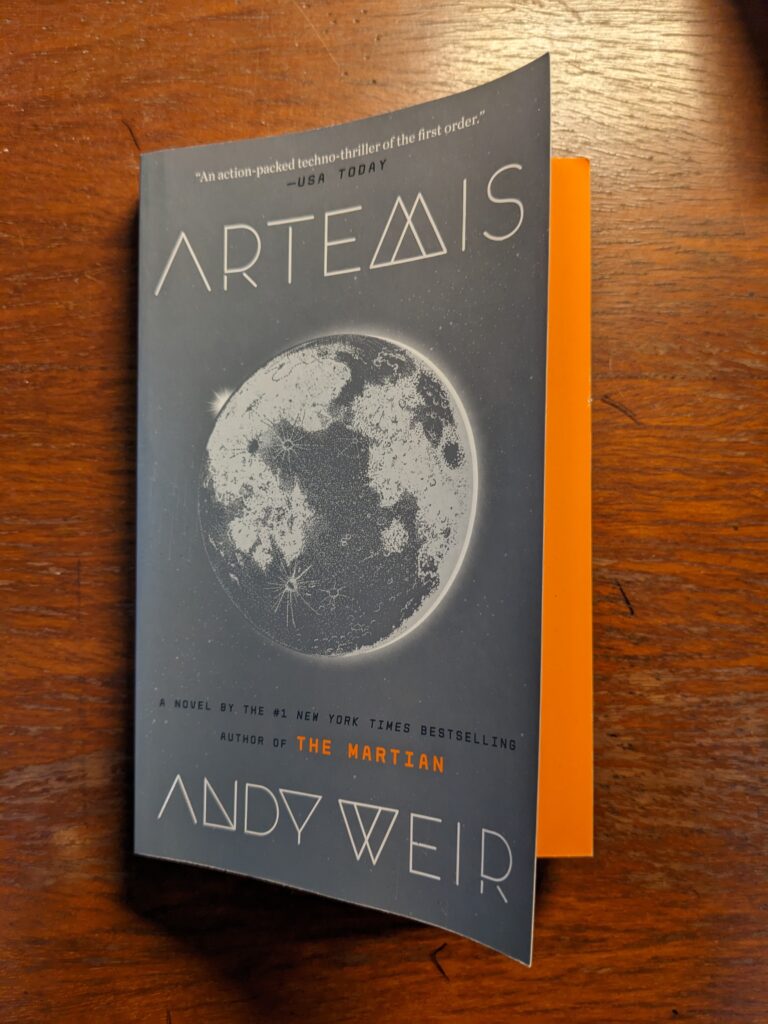
I just finished Andy Weir’s Artemis. I’ve previously read two other books by Weir, The Martian (2011) and Project Hail Mary (2021), both of which I thoroughly enjoyed. Artemis has a different feeling from those that is hard to put my finger on. It is a solid science fiction novel and is diverting. It reminds me a bit of Futuristic Violence and Fancy Suits (2015) by Jason Pargin, but not quite as madcap and raunchy. The developing pen-pal letters at the ends of the chapters are a nice touch.
It has a lot of action, but a big component behind the scenes is how a moon economy would actually work. I liked the extra section after the end of the book that Weir added to illustrate his reasoning in designing the economic system.
For me personally, it doesn’t rise to the level of The Martian and Project Hail Mary, but I would recommend it.
I’ve started using an index card as a bookmark when reading, and when I come across a word that I don’t know, I write it down on the card to look up later. I also do this with some words that I know the definition of but am not sure how to spell or for words I know but hardly ever use myself as a reminder to practice and expand my working vocabulary. Here is my word list for Artemis:
- Anorthite—A mineral made of calcium, aluminum, silicon, and oxygen that weathers easily (on Earth) and is rare on Earth but common on the Moon.
- Berm—An artificial ridge of soil or rock. This is a word I knew but, for some reason, never use.
- Buster Keaton—a famous actor in silent film comedies. I’ve heard references to him over the years but don’t know much about him. (The ensuing discussion from listing him here resulted in another blog post.)
- Collet—A tapered metal collar that surrounds, aligns, and holds another piece, like the chuck on a drill that holds the drill bit.
- Dhuku—Shona, an African-style woman’s headwrap.
- Docent—a person acting as a temporary guide to a small group of people.
- Eli Wallach—an actor. One of his most famous roles, and relevant to this book, was as Tuco in the spaghetti western The Good, the Bad and the Ugly.
- Exudate—a fluid that leaks out of blood vessels or a liquid secreted by an organism. Like niqab, the book made it a bit funny that I wrote this down.
- FFC Cambridge process—an electrical way to produce metals from their metal oxides (as in ore) by electrolysis with calcium salts. The oxygen leaves the metal and combines with the calcium under heat and electricity, leaving behind the purified metal.
- Frumpy—unfashionable or old-fashioned in appearance, usually used to describe a woman (just not a word that I use a lot).
- Khula—Arabic: خلع Khulʿ, the process where a woman initiates a divorce in Islamic law.
- Manaus—A large city in northwestern Brazil.
- Moltke—I have this written down, but now I am not sure why. A Prussian general? He said, “no plan survives contact with the enemy”; perhaps this is the reference (I can’t remember).
- Niqab—Arabic: نِقاب niqāb, a veil that covers the lower part of a woman’s face. (It was funny that I wrote this down; you’ll see why on the next page when you read the book.)
- Pedantic—picky over details in an irritating way. Another word that I almost never use.
- Regolith—loose dry sand, dust, and small rocks on the surface.
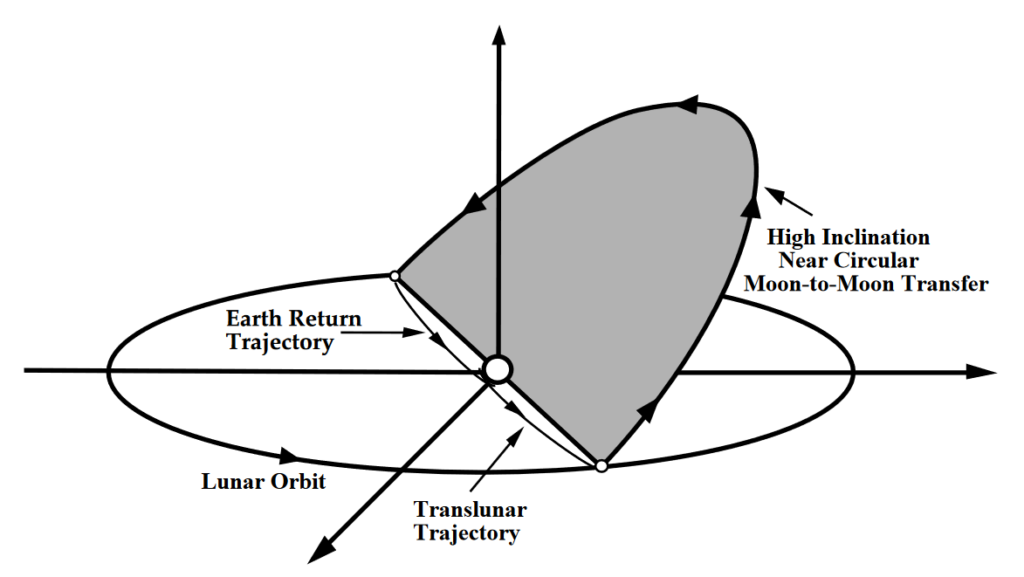
- Uphoff-Crouch cycler orbit—This one could be a whole blog post by itself. It is explained in the book, but it is not a spoiler to mention it here. In short, it is a proposed efficient orbit, with built-in processing time at each destination, to shuttle supplies between the Earth and Moon. The trick is the Moon is moving in its orbit around the Earth, so you can’t just have a direct path back and forth. This goes from the Earth to the Moon, then swings out away from the Moon, orbiting the Earth out of the Moon’s plane but at the same distance away, and catches the Moon as they intersect on the opposite side of its orbit, then returns to the Earth and starts over. (See the figure after this list.)
- Uphoff, C., & Crouch, M. A. (1993). Lunar cycler orbits with alternating semi-monthly transfer windows. Journal of the Astronautical Sciences, 41(2), 189-205.
- Yiddish and Yiddish-derived words in English—schmoe (a form of schmuck, an idiotic obnoxious person) and kitsch (tasteless art or a cheap imitation). I know what these mean, but I can never remember how to spell them correctly. The sch combination throws me off. Tchotchke (small cheap collected objects, knick-knacks, without a common theme) wasn’t even in this book, but I’m throwing it in here because whenever I try to look up how to spell it, I misspell it so badly (the tch combination) that all I end up with are Russian composers (however, it did move from a Slavic origin to Yiddish); let’s throw French bric-à-brac (the same meaning as tchotchke) in while we’re at it.
Links
- Amazon.com page for Artemis, https://www.amazon.com/dp/0553448145
- Wikipedia page for Artemis, https://en.wikipedia.org/wiki/Artemis_(novel)
Leave a Reply to Buster Keaton—how did I miss this? – Floyd’s Blog Cancel reply